Videos de Tecnología
Videos sobre avances tecnológicos, gadgets y tendencias digitales.
Tecnología 440 videos

India Gets Access To Secret AI Cyber Weapon? What's Next For Indian Investors? Claude Mythos
India has reportedly received access to Claude Mythos Preview — Anthropic’s powerful cybersecurity-focused AI model designed to detect software vulnerabilities before hackers exploit them. Reports suggest even NPCI, which operates UPI, has shown interest in Mythos-level capabilities as India’s digital payment ecosystem faces growing cyber threats. The AI has already helped identify over 10,000 high and critical security flaws across major systems under Anthropic’s Project Glasswing initiative. But there’s a catch: the same AI that can protect systems could also be misused by attackers to discover vulnerabilities faster. As Anthropic prepares for its IPO, Mythos shows how the AI race is now expanding beyond chatbots into cybersecurity, governments, and critical infrastructure.

ESCÁNDALO EN EUROPA: El absurdo de la regulación que deja SIN IA a los nuevos iphones de Apple
ESCÁNDALO EN EUROPA: El absurdo de la regulación que deja SIN IA a los nuevos iphones de Apple Analizamos la alarmante brecha tecnológica que se abre entre la Unión Europea y el resto del mundo desarrollado tras la confirmación oficial de Apple: el despliegue de su esperada Inteligencia Artificial, Siri AI, queda completamente suspendido de forma indefinida en toda Europa. Mientras los usuarios de Estados Unidos y Asia se preparan para dar el salto definitivo en productividad y computación espacial, los ciudadanos europeos seremos los únicos que compraremos los nuevos modelos de iPhone y iPad totalmente capados de inteligencia artificial. Desglosamos el impacto de la Ley de Mercados Digitales (DMA), una normativa de Bruselas que exige a Apple abrir el núcleo de su sistema operativo y otorgar acceso directo a datos ultra privados —como mensajes, fotos y correos electrónicos— sin filtros de seguridad, una exigencia que la firma tecnológica ha rechazado frontalmente para proteger la privacidad del usuario. Descubre en este vídeo cómo la burocracia de los líderes europeos, asimilando su control estatal al de la censura de China, pone un tapón social al desarrollo empresarial y condena al continente a competir con "máquinas de escribir frente a ordenadores". #apple #siri #europa #iphone #inteligenciaartificial #ia #appleintelligence #tecnologia #wallstreet #noticias #negociostv #vizner 🔞Exención de responsabilidad: Toda la información, material y / o contenido incluido en este programa es sólo para fines informativos y educativos. Invertir en acciones, opciones y futuros es arriesgado y no es adecuado para todos los inversores. Consulte a su propio asesor financiero independiente antes de tomar cualquier decisión de inversión. Negocios TV no se hace responsable de las opiniones expresadas en el vídeo.
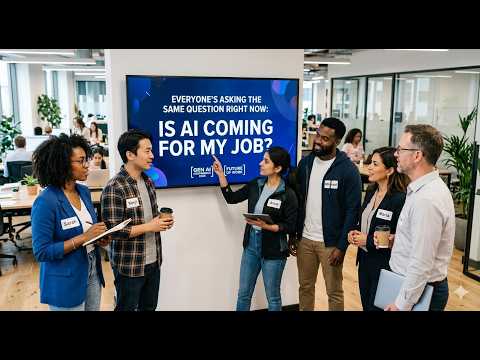
🥇 AI Will Replace Millions of Jobs... But Not This One
Will AI replace your job? With artificial intelligence advancing faster than ever, millions of people are wondering what the future of work will look like. AI can write, code, create art, analyze data, and automate countless tasks—but are there jobs it simply can't replace? In this video, we explore the one key factor that makes certain careers more resistant to automation: human trust, empathy, judgment, and real-world relationships. You'll learn: ✅ Which jobs are most vulnerable to AI ✅ Why some careers are likely to survive the AI revolution ✅ The skills that will remain valuable in the future ✅ How humans and AI may work together instead of competing Whether you're a student, professional, entrepreneur, or simply curious about the future, this video will help you understand where AI is heading and what it means for your career. 💬 What job do you think AI will never fully replace? Let us know in the comments! 👍 If you enjoyed this video, don't forget to Like, Share, and Subscribe for more content about AI, technology, careers, and the future of work. #AI #ArtificialIntelligence #FutureOfWork #Technology #Jobs #CareerAdvice #Automation #AIJobs #FutureCareers #Innovation #TechNews #MachineLearning #Workplace #Productivity #Education

🛡️ REGRESIÓN LOGÍSTICA: Clasificación Inteligente desde cero | Machine Learning | Cap. 11
¡Bienvenidos a un nuevo capítulo del curso "Machine Learning para Todos"! 📘🚀 En lecciones anteriores aprendimos a predecir valores continuos con la Regresión Lineal y a medir sus errores. Pero, ¿qué pasa cuando la pregunta no es "¿cuánto vale?", sino "¿qué es?"? ¿Spam o no spam? ¿Compra o no compra? Hoy entramos de lleno en el mundo de los problemas de Clasificación Binaria. Y para empezar, usaremos el algoritmo fundamental: la Regresión Logística. No dejes que el nombre te engañe; aunque dice "regresión", su superpoder es clasificar. En este vídeo desglosaremos la lógica matemática (la función sigmoide 📉), entenderemos cómo funciona la probabilidad y lo implementaremos paso a paso en Python usando nuestra herramienta favorita, Scikit-Learn. Saber clasificar datos es el primer gran paso para crear IAs que tomen decisiones reales. ¡No te lo pierdas! 🧠⚡ Puedes acceder al libro publicado en Amazon, desde aqui: https://www.amazon.es/dp/B0CW17NBGM Conviértete en miembro de este canal para disfrutar de ventajas: https://www.youtube.com/channel/UCXk7hdEZ7JxauhESxwKJadw/join Tambien puedes visitar mi repositorio GitHub - https://github.com/josecodetech Y no olvides seguirme en las principales redes: Twitter - https://twitter.com/josecodetech BlueSky - https://bsky.app/profile/josecodetech.bsky.social Instagram - https://www.instagram.com/josecodetech Facebook - https://www.facebook.com/josecodetech/ Tik-tok - https://www.tiktok.com/@joseojedarojas #josecodetech #programacion #desarrollo #formacion

How LLMs Understand your Prompts: Tokenization & Embeddings | Chapter 05
What are vector embeddings and tokenization, and how do they let an LLM understand meaning? This video explains tokenization, embeddings, vector dimensions, cosine similarity and positional embeddings - with a hands-on coding demo. ===== In this video, you will learn ===== • What tokenization is and the main types of tokenizers (incl. Byte Pair Encoding) • What vector embeddings are, and what vectors & dimensions actually mean • How an LLM captures meaning using embeddings • How cosine similarity measures how "close" two pieces of text are • Positional embeddings - how models know word order • A hands-on Python demo: tokenizer + embeddings in code This is Part 5 of the GenAI Fundamentals series - for data engineers, developers, and anyone learning how AI language models actually work. ===== Chapters ===== 00:00 - Introduction 00:32 - What is Tokenization and Vector Embeddings? 03:41 - What are Vectors and Dimensions? 06:37 - Why Vectors matter for LLMs? 07:59 - How meaning is captured using Embedding? 12:30 - What is Cosine Similarity? 14:08 - Types of Tokenizers 17:50 - (Hands on) Coding for Tokenizer and Embeddings 26:48 - What are Positional Embeddings? ===== Links ===== Google's "Attention is all You Need" Paper - https://arxiv.org/pdf/1706.03762 Groq Cloud - https://console.groq.com/home GPT Tokenizer - https://platform.openai.com/tokenizer Google Collab - https://colab.research.google.com/ Byte Pair Encoding (BPE) - https://www.geeksforgeeks.org/nlp/byte-pair-encoding-bpe-in-nlp/ Github Code - https://github.com/subhamkharwal/genai-for-data-engineers/blob/master/codes/genai_chap05.ipynb ===== Other Playlists ===== Checkout all other playlists on Data Engineering 👇🏻 https://www.youtube.com/@easewithdata/playlists ===== GitHub Repo ===== https://github.com/subhamkharwal https://github.com/subhamkharwal/genai-for-data-engineers ===== Connect with ME ===== LinkedIn - https://www.linkedin.com/in/subhamkharwal Medium - https://subhamkharwal.medium.com ===== Hashtags ===== #VectorEmbeddings #Tokenization #LLM #GenerativeAI #genai #dataengineering #python #neuralnetworks #machinelearning

IA y el Futuro del Empleo: lo que nadie te cuenta ⚠️
La inteligencia artificial ya no es una promesa tecnológica: se está convirtiendo en una fuerza capaz de redefinir el mercado laboral global. Mientras gran parte del debate se centra en las oportunidades, cada vez más instituciones comienzan a advertir sobre los riesgos que podrían surgir para millones de trabajadores. Este análisis aborda el cambio de postura de The Economist respecto a la IA y el futuro del empleo, explorando por qué una de las publicaciones más influyentes del mundo ha pasado del optimismo tecnológico a plantear escenarios de profunda disrupción económica y social. La transformación impulsada por la inteligencia artificial no se limita a la automatización de tareas repetitivas. Los avances en modelos generativos, automatización cognitiva y agentes autónomos están comenzando a afectar actividades tradicionalmente reservadas a profesionales cualificados. Este fenómeno plantea interrogantes sobre productividad, salarios, empleo cualificado, distribución de la riqueza y estabilidad económica. El contenido examina conceptos históricos como la pausa de Engels, una etapa en la que el crecimiento de la productividad no se tradujo inmediatamente en mejoras para la mayoría de la población. Bajo esta perspectiva, se analiza si la actual revolución tecnológica podría generar un escenario similar, caracterizado por una mayor concentración del capital, una presión creciente sobre el empleo y una ampliación de las desigualdades económicas. También se evalúan algunas de las respuestas propuestas por economistas, gobiernos y organismos internacionales, incluyendo reformas fiscales, renta básica universal, nuevas políticas de redistribución y mecanismos de adaptación laboral. Al mismo tiempo, se plantea la importancia de la responsabilidad individual, la adquisición de nuevas capacidades y la construcción de activos propios en un entorno cada vez más competitivo. Las implicaciones de este cambio trascienden el ámbito laboral. La inteligencia artificial está modificando la relación entre empresas, trabajadores y Estados, generando desafíos que afectan a la economía global, la estabilidad social y la capacidad de las instituciones para adaptarse a una transformación sin precedentes. Lo que ocurra durante la próxima década podría definir el equilibrio económico de las próximas generaciones. La cuestión ya no es si la inteligencia artificial cambiará el trabajo, sino a qué velocidad lo hará y quién estará preparado para adaptarse. Comprender esta transición puede convertirse en uno de los factores más importantes para navegar el nuevo escenario económico que comienza a emerger. Este contenido tiene fines exclusivamente informativos y educativos. Las opiniones expresadas en el video pertenecen y estan creadas por iA en base a la informacion que se encuentra en internet y no constituyen asesoramiento legal, financiero o profesional de ningún tipo. El canal no se hace responsable de interpretaciones externas, decisiones tomadas a partir del contenido ni de posibles usos indebidos de la información presentada. Cada espectador es responsable de verificar los datos y actuar conforme a la legislación vigente en su país. En ningún caso se promueve, incita o justifica la realización de actividades ilegales. Cualquier acción que infrinja la ley es responsabilidad exclusiva de quien la lleve a cabo. #inteligenciaartificial, #ia, #empleo, #futurodeltrabajo, #automatizacion, #economia, #tecnologia, #mercadolaboral, #productividad, #trabajo, #innovacion, #transformaciondigital, #crisislaboral, #economiaglobal, #geopolitica, #theeconomist, #rentauniversal, #desigualdad, #empleosdel futuro, #revoluciontecnologica

Module 1 Introduction to the EU AI Act
An overview of the European Union Artificial Intelligence Act (EU AI Act), introducing the regulatory framework established to govern the development, deployment, and use of artificial intelligence within the European Union. Key topics include the objectives and scope of the regulation, fundamental definitions, and the risk-based approach that forms the foundation of the Act. This content provides essential context for understanding the regulatory requirements and compliance expectations applicable to AI systems.


Regulación digital europea: 8 normas que las empresas no pueden ignorar
La regulación digital europea ya no es un asunto técnico reservado a abogados o departamentos de cumplimiento. Es una variable estratégica que afecta a empresas tecnológicas, financieras, industriales, plataformas digitales, proveedores de servicios, operadores de datos y compañías que quieran operar con seguridad en el mercado europeo. En este vídeo reunimos ocho claves sobre el nuevo marco regulatorio europeo: RGPD / GDPR — Reglamento General de Protección de Datos. Reglamento (UE) 2016/679. AI Act / RIA — Reglamento de Inteligencia Artificial. Reglamento (UE) 2024/1689. NIS2 — Directiva sobre un nivel común elevado de ciberseguridad en la Unión. Directiva (UE) 2022/2555. DORA — Reglamento de Resiliencia Operativa Digital del Sector Financiero. Reglamento (UE) 2022/2554. MiCA — Reglamento sobre los Mercados de Criptoactivos. Reglamento (UE) 2023/1114. CRA — Reglamento de Ciberresiliencia. Reglamento (UE) 2024/2847. DSA — Reglamento de Servicios Digitales. Reglamento (UE) 2022/2065. Data Act — Reglamento de Datos. Reglamento (UE) 2023/2854. Ocho normas. Ocho impactos. Una misma conclusión: las empresas que no entiendan la arquitectura regulatoria europea llegarán tarde, asumirán más riesgo y perderán capacidad competitiva. En META Channel Corporation trabajamos la regulación digital europea no como teoría, sino como estrategia jurídica, tecnológica y corporativa aplicable a empresas reales. META Channel Corporation Derecho Internacional Privado · Regulación Digital Europea · Estrategia Corporativa Con Antonio Tejeda CEO de META Channel Corporation Presidente del Comité Euro Americano de Derecho Digital - CEA Digital Law Hashtags: #RegulaciónDigital #DerechoDigital #RGPD #GDPR #AIAct #RIA #NIS2 #DORA #MiCA #CRA #DSA #DataAct #Ciberseguridad #UniónEuropea #METAChannelCorporation #SmartMeeting

How to Build an LLM From Scratch in PyTorch
I implemented a Transformer/LLM from scratch in PyTorch and trained it as a small GPT like language model. The goal of this video is to understand how modern LLMs work under the hood by implementing a language model from scratch, inspired by the Attention Is All You Need paper. We start with the dataset and tokenization, then build embeddings, positional encoding, masked multi head attention, decoder blocks, and the full PyTorch training loop.This is a decoder only Transformer trained with next token prediction, similar in spirit to GPT. For the dataset I use Yu Gi Oh cards, which makes the final output a bit more fun than another Shakespeare example. Code: https://github.com/vossenwout/llm-from-scratch Paper: https://arxiv.org/abs/1706.03762 Timestamps: 00:00 - Building a Transformer from Scratch in PyTorch 01:15 - Why train on Yu-Gi-Oh cards? 03:05 - Downloading and preprocessing the dataset 08:25 - Building tokenizers for our language model 12:40 - Byte Pair Encoding tokenizer explained 19:15 - Creating a PyTorch dataset 20:35 - Next-token prediction explained 21:45 - Transformer input and output shapes 27:40 - Decoder-only Transformers explained 30:55 - Token embeddings and positional encoding 39:10 - Implementing the Transformer decoder 41:30 - Multi-head attention explained 49:40 - Causal masking for GPT-style models 57:05 - Implementing multi-head attention in PyTorch 1:00:20 - Optimizing attention (vectorization) 1:05:00 - Residual connections, dropout, and layer norm 1:09:25 - Feed-forward networks in Transformers 1:13:25 - Stacking decoder blocks 1:16:40 - Building the PyTorch training loop 1:21:35 - Cross entropy loss and optimization 1:29:50 - Validation loss, perplexity, and checkpoints 1:32:00 - Training the Transformer model 1:34:25 - Training results and overfitting 1:35:45 - Building the inference script 1:38:45 - Sampling tokens with temperature 1:41:20 - Generating AI Yu-Gi-Oh cards 1:44:00 - Opening AI-generated booster packs 1:48:30 - Final thoughts #pytorch #llm #deeplearning

Day - 03 : GEN AI + LLM + RAG + Agentic AI Overview by Mr. Ashok
Artificial Intelligence is changing the way software applications are built. In this session, Mr. Ashok explains the most important AI concepts every student and developer should know. In this video, you will learn: ✅ What is Generative AI? ✅ What are Large Language Models? ✅ How RAG works in real-time applications ✅ What is Agentic AI? ✅ Difference between LLM, RAG, and AI Agents ✅ Real-world use cases of Gen AI ✅ Career opportunities in AI This session is useful for students, freshers, working professionals, Java developers, Python developers, and anyone who wants to start learning AI from basics. 📌 Watch the full session and start your AI learning journey today. #GenAI #LLM #RAG #AgenticAI #ArtificialIntelligence #AIOverview #GenerativeAI #PromptEngineering #AIForBeginners #AshokIT #MrAshok #PythonAI #AICareer #MachineLearning #TechLearning

La IA que HABLA como UN HUMANO: ¿CÓMO FUNCIONA por DENTRO? | LLM PARTE 1
En este video analizaremos cómo funcionan los modelos de lenguaje que están revolucionando el mundo, desde los conceptos más básicos hasta la arquitectura que les dio vida. Sin tecnicismos, con ejemplos del día a día, para que lo entienda hasta tu abuela. Esta es la primera parte de una serie donde iremos paso a paso, desde lo más fundamental, conectando ideas cotidianas con las redes neuronales, hasta llegar a entender qué hay detrás de tecnologías como ChatGPT o Claude. 🌐 Sígueme en otras redes: 🔴 YouTube: / https://www.youtube.com/@kunSure%C3%B1o 📱 Instagram: https://www.instagram.com/kunsurenio 📱 TikTok: https://www.tiktok.com/@kunsurenio 💻Twitter/X: https://x.com/CumlouderSanti 🎧 Spotify: https://open.spotify.com/ 💼 LinkedIn: https://kunsureniorbg.github.io/porfolio/en/ Contacto profesional/sponsor: poncearrochasanti@gmail.com Si te gusta el contenido, no olvides darle Like, Hype, suscribirte y activar la campanita 🔔 para no perderte nada de lo que viene.