Videos de Educación
Videos educativos y de formación.
Educación 184 videos

La IA que HABLA como UN HUMANO: ¿CÓMO FUNCIONA por DENTRO? | LLM PARTE 1
En este video analizaremos cómo funcionan los modelos de lenguaje que están revolucionando el mundo, desde los conceptos más básicos hasta la arquitectura que les dio vida. Sin tecnicismos, con ejemplos del día a día, para que lo entienda hasta tu abuela. Esta es la primera parte de una serie donde iremos paso a paso, desde lo más fundamental, conectando ideas cotidianas con las redes neuronales, hasta llegar a entender qué hay detrás de tecnologías como ChatGPT o Claude. 🌐 Sígueme en otras redes: 🔴 YouTube: / https://www.youtube.com/@kunSure%C3%B1o 📱 Instagram: https://www.instagram.com/kunsurenio 📱 TikTok: https://www.tiktok.com/@kunsurenio 💻Twitter/X: https://x.com/CumlouderSanti 🎧 Spotify: https://open.spotify.com/ 💼 LinkedIn: https://kunsureniorbg.github.io/porfolio/en/ Contacto profesional/sponsor: poncearrochasanti@gmail.com Si te gusta el contenido, no olvides darle Like, Hype, suscribirte y activar la campanita 🔔 para no perderte nada de lo que viene.

What is Text-to-Image AI? 🎨🤖 Explained in 60 Seconds | AI Terminology #19 #AI #CareerClust #Shorts
🎨 What is Text-to-Image AI? Text-to-Image AI is a type of Generative AI that creates images from written descriptions (prompts). Simply describe what you want, and the AI generates a unique image in seconds. Popular examples include: ✅ DALL·E ✅ Midjourney ✅ Stable Diffusion ✅ Adobe Firefly In this video, you'll learn: 🔹 What Text-to-Image AI is 🔹 How it works 🔹 The role of prompts 🔹 Real-world applications in design, marketing, gaming, and content creation 📚 AI Terminology Series – Part 19 Follow CareerClust for simple and practical AI concepts explained in under a minute. #CareerClust #TextToImageAI #GenerativeAI #AI #ArtificialIntelligence #PromptEngineering #Dalle #Midjourney #StableDiffusion #AIArt #AITerminology #TechShorts #LearnAI #AIForBeginners #ContentCreation #DigitalArt #YouTubeShorts #Shorts

¡Redes Neuronales que Explican sus Decisiones! El Diccionario Interpretable en Sparse Coding
Las redes neuronales artificiales, especialmente los modelos de aprendizaje profundo, a menudo son consideradas "cajas negras". Esto se debe a que su funcionamiento interno y la forma en que representan los datos son increíblemente complejos y difíciles de interpretar para los humanos. No podemos entender fácilmente por qué toman una decisión específica, lo cual es un problema fundamental cuando queremos confiar en sistemas de inteligencia artificial para tareas críticas. Este estudio presenta un enfoque novedoso para entrenar una red neuronal de una manera que sus componentes internos sean comprensibles, inspirándose en los mecanismos de representación y aprendizaje del cerebro de los mamíferos. Utilizando una técnica llamada "codificación dispersa" (sparse coding), el modelo aprende un "diccionario" de elementos que son más fáciles de entender. A diferencia de los modelos tradicionales, este método obliga a la red a ser selectiva, utilizando solo unos pocos elementos para explicar una entrada de datos, de forma similar a como nuestro cerebro procesa la información de manera eficiente. Los resultados demuestran que el modelo de codificación dispersa ofrece beneficios tanto cualitativos como cuantitativos en la interpretación en comparación con modelos equivalentes como los autoencoders convolucionales. Las representaciones internas aprendidas son mucho más claras y selectivas, lo que permite a los investigadores entender la contribución de cada neurona a la decisión final del sistema. Este trabajo es un paso adelante hacia la creación de una inteligencia artificial más transparente y fiable. Link al paper: https://arxiv.org/pdf/2011.11805 Autores del estudio: Edward Kim, Connor Onweller, Andrew O'Brien, Kathleen McCoy Apoyanos en https://www.patreon.com/audioarxiv Unete en https://discord.gg/vKRmFhg4YQ #Ciencias de la computación #InteligenciaArtificial #MachineLearning #RedesNeuronales #DeepLearning #IAExplicable

Como criar e salvar estilos para usar na criação de Imagens com IA
Como criar estilos para criação de imagens Link: https://ideogram.ai/t/explore 👉Meu curso completo sobre Inteligências Artificiais com foco em renda extra e viver de internet: https://pay.kiwify.com.br/OUx0Hgb ✅Playlist de cursos gratuitos: https://youtube.com/playlist?list=PLNQBpbIienGEf4oI5z3wFOd_qexy0UrUe&si=oAqDO7cqeYPFB6X6 Editor: designersalvatore@gmail.com Neste canal, abordamos o que é a inteligência artificial e como ela está sendo aplicada em diferentes áreas, como tecnologia. Discutimos tipos de IA, como aprendizado profundo e racional, e os desafios e oportunidades que ela traz. O objetivo aqui é apresentar ferramentas de IA que facilitem o trabalho cotidiano das pessoas e como elas podem se preparar para o futuro com ela. Inscreva-se neste canal se quiser facilmente encontrar maneiras de trabalhar de forma independente, usando ferramentas como Midjourney, Stable diffusion, DALL·E 2, ChatGPT, etc. #midjourney #Stablediffusion #promptformidjourney #midjourneyai #chatgpt

How LLMs Actually Generate Text (Every Dev Needs to See This)
Every day, millions of people use ChatGPT, Claude, and Grok—but very few understand what is actually happening behind the blinking cursor. Did you know the model has no idea what it's going to say next? In this video, we break down the exact 5-step process of how Large Language Models (LLMs) generate text, from the moment you hit "send" to the final output. We move past the magic and dive into the mechanism so you can become a better AI builder. You’ll learn exactly how AI reads text, how it understands context, and why "hallucinations" actually happen. 👇 What You Will Learn (Chapters): 0:00 - The Illusion of AI (No Hidden Script) 0:28 - The 5 Steps of LLM Text Generation 0:54 - Step 1: Tokenization (How Models Read) 1:56 - Step 2: Embeddings (Mapping Meaning & Context) 3:11 - Step 3: Transformers & The Attention Mechanism 4:40 - Step 4: Probabilities (Logits & Softmax) 5:40 - Step 5: Sampling (Greedy Decoding, Temperature & Top-P) 6:52 - Autoregressive Generation (The Loop) 7:50 - Why AI Hallucinates (Mechanism, Not Magic) 8:50 - Summary: Becoming an AI Builder If you want to understand the architecture of modern AI, hit the LIKE button and SUBSCRIBE for more deep dives into machine learning and software engineering. #ChatGPT #LLM #MachineLearning #ArtificialIntelligence #Transformers #OpenAI #TechEducation #LLM #HowAIWorks #ChatGPT #MachineLearning #ArtificialIntelligence #NeuralNetworks #Transformers #TechExplained #Programming #OpenAI #Claude 🏷️Keywords ChatGPT, OpenAI, Large Language Models, LLM, Claude, Grok, Artificial Intelligence, AI explained, Machine Learning, Neural Networks, Deep Learning, Generative AI, generative text, Specific & Technical Tags: Tokenization, AI tokens explained, Word embeddings, Transformer model explained, Attention mechanism AI, Self attention, Softmax function, AI logits, Top-p sampling, Nucleus sampling, AI Temperature setting, Greedy decoding, Autoregressive models, Llama 3, GPT-4, Long-Tail/Search Query Tags: How does ChatGPT work, How large language models work, What is a token in AI, Transformer neural network explained simply, How AI generates text, Why does AI hallucinate, ChatGPT temperature explained, How to write better AI prompts, Mechanism not magic, Learn AI for beginners, How to build with LLMs, AI context window explained,

Reverse Engineer the Linear Combination | #mathmachinelearning | #linearalgebra | #dogmathic
#LinearAlgebra #MathForML #MachineLearning #VectorSpaces #MLMath Seven Steps of Row Reduction to Find Three Numbers. Math Is Humbling. Linear combinations and Gauss-Jordan elimination show up together here because they always show up together. This is Exercise 2.11 from Mathematics for Machine Learning, and the job is straightforward: given a target vector y and three other vectors, find the scalars λ₁, λ₂, λ₃ that make the combination work. The definition of a linear combination fits in one line. Definition 2.11, page 40: scale each vector, add them up, get something new. That is the whole thing. The exercise runs it backwards. We have the result (y), we have the vectors, and we need to find the scalars. Which means setting up a system of three equations in three unknowns. Which means an augmented matrix. Which means Gauss-Jordan, whether you wanted it or not. Seven elimination steps: zero out the first column, zero out the second, scale the third pivot, then back-substitute up through row one. The matrix grinds. The answer reads off cleanly at the end: λ₁ = −6, λ₂ = 3, λ₃ = 2. So y = −6x₁ + 3x₂ + 2x₃. Short video. Boring in the best way. The kind of problem that makes linear algebra feel like plumbing, which is not entirely wrong. Linear combinations are the foundation of everything that comes later in this subject. Topics covered: linear combination, Gauss-Jordan elimination, augmented matrix, row reduction, pivot, back substitution, systems of linear equations, vector spaces, scalars, Mathematics for Machine Learning, linear algebra, MML exercise, matrix row operations, RREF, discrete math Support Dogmathic https://ko-fi.com/dogmathic https://dogmathic.com/ matherssen(at)gmail.com https://youtu.be/sUrdV31_084 https://youtu.be/qXZ4sXgJFGk https://youtu.be/rCqL-ZhAK5g https://youtu.be/0msRpIW2kAw https://youtu.be/_X9D7YS9oEQ https://www.youtube.com/playlist?list=PLm90IN9RVLf-hf1BPIxN6lW2oqfP8a4Mq https://www.youtube.com/playlist?list=PLm90IN9RVLf-8Ht5hWSodKFwOOG-FWxBx https://www.youtube.com/playlist?list=PLm90IN9RVLf-W0SGnXjWpP3r8wm6Vq1mn https://www.youtube.com/playlist?list=PLm90IN9RVLf9hn9po3pPHzK540MCY6XMY https://www.youtube.com/playlist?list=PLm90IN9RVLf-mwflhqqrGCQHUWDWgomcB Properties and Concepts Used: Linear combination (Definition 2.11, MML p. 40) Augmented matrix construction (stacking column vectors) Gauss-Jordan elimination Forward elimination (zeroing entries below pivots) Back substitution (zeroing entries above pivots) Row scaling (multiplying a row by a scalar) Pivot identification Reduced row echelon form (RREF) Systems of linear equations (3×3) Vector representation in Rⁿ Scalar multiplication on vectors Vector addition Unique solution existence (full-rank system) Chapters: 0:00 Introduction and book context 0:22 Definition 2.11: linear combinations 0:54 Building the augmented matrix 1:18 Forward elimination (steps 1-4) 2:13 Back substitution (steps 5-7) 2:59 Reading off λ₁, λ₂, λ₃ 3:13 Final answer: y = −6x₁ + 3x₂ + 2x₃ #LinearAlgebra #MathForML #MachineLearning #VectorSpaces #MLMath

Así funciona una IA por dentro: lo que nadie te había explicado
¿Alguna vez te has preguntado qué pasa realmente dentro de una inteligencia artificial cuando le haces una pregunta? En este video lo descubrirás todo, desde cómo convierte tus palabras en números, hasta cómo genera su respuesta token a token. Lo que vas a descubrir: Qué son los tokens y por qué la IA no lee como tú Cómo las palabras se convierten en vectores matemáticos Qué es el mecanismo de atención y para qué sirve Por qué una IA a veces se equivoca o alucina Cuánta energía y hardware se necesita para entrenar un modelo Inteligencia artificial explicada. Cómo funciona ChatGPT. Cómo funciona una IA. Qué es un modelo de lenguaje. Qué es GPT. Cómo aprende una IA. Redes neuronales explicadas. Qué son los tokens en IA. Cómo funciona el aprendizaje automático. Machine learning en español. Deep learning explicado. Qué es un transformer. Cómo funciona GPT-4. Inteligencia artificial para principiantes. IA explicada fácil. Cómo funciona la IA por dentro. Qué es ChatGPT. Cómo responde una IA. Por qué la IA se equivoca. Alucinaciones en inteligencia artificial. Parámetros de un modelo de IA. Entrenamiento de inteligencia artificial. Vectores en inteligencia artificial. Mecanismo de atención IA. Transformer explicado en español. IA 2024. IA 2025. Tecnología explicada en español. Aprender inteligencia artificial desde cero. Inteligencia artificial youtube. Canal de tecnología en español. 🔔 Suscríbete si este video te hizo ver algo que antes no veías. 📌 Canal Por Dentro — Explicamos por qué las cosas funcionan así. #InteligenciaArtificial #IA #ChatGPT #ComoFuncionaUnaIA #MachineLearning #TecnologiaEnEspañol #AprendeIA #RedesNeuronales #DeepLearning #Transformer #ModeloDelenguaje #GPT4 #IAPrincipiantes #AprendeDesde cero #TecnologiaIA #ArtificialIntelligence #ChatGPTEspañol #IAExplicada #NLP #OpenAI

¿Cómo funciona ChatGPT?
Anaizo cómo funciona ChatGPT desde una perspectiva técnica y divulgativa. Revisamos cómo se entrenan los grandes modelos de lenguaje, de qué manera procesan texto y por qué pueden producir respuestas que muchas veces resultan sorprendentemente coherentes. • Qué es un gran modelo de lenguaje (LLM) • Cómo aprende una inteligencia artificial como ChatGPT • Qué ocurre cuando ingresamos un prompt • Por qué la IA puede generar texto con apariencia humana • Cuáles son sus fortalezas y limitaciones #ChatGPT #InteligenciaArtificial #ModelosDeLenguaje #TransformacionDigital #TecnologiasDisruptivas Si valoras el análisis riguroso de las tecnologías que están redefiniendo nuestro tiempo, suscríbete a Ovejas Eléctricas, activa las notificaciones y comparte este video. Tu participación ayuda a seguir generando contenido que conecta ciencia, tecnología y sociedad desde una mirada crítica y fundamentada.

3 AI Image Generators Compared
3 AI Image Generators Compared — The best best AI image generators compared Midjourney vs DALL-E vs Stable Diffusion strategies working right now in 2026, tested and explained step by step. 📺 WHAT YOU'LL LEARN: ✅ Pillar 1: Introduction to AI Image Generators ✅ Pillar 2: Top AI Image Generators Compared ✅ Pillar 3: Tips and Tricks for Getting the Most Out of AI Image Generators ✅ Pillar 4: Common Mistakes to Avoid When Using AI Image Generators ✅ Pillar 5: Real-World Applications of AI Image Generators 🛠️ TOOLS MENTIONED IN THIS VIDEO: • Midjourney • Grok • ChatGPT • Gemini • Runway ⏱️ TIMESTAMPS: 00:00 — Introduction 00:20 — Pillar 1: Introduction to AI Image Generators 01:50 — Pillar 2: Top AI Image Generators Compared 03:50 — Pillar 3: Tips and Tricks for Getting the Most Out of AI Image Generators 05:20 — Pillar 4: Common Mistakes to Avoid When Using AI Image Generators 06:50 — Pillar 5: Real-World Applications of AI Image Generators 08:50 — Conclusion & Next Steps 🔔 Subscribe to AiKLUG for weekly AI tools & productivity tips — we test everything so you don't have to. If you're searching for the best vs, best, ai tools — this video covers it all with no fluff, just actionable steps you can use today. 📧 Business: contact@aiklug.com #AITools #ArtificialIntelligence #bestAIimagegeneratorscomp #AIProductivity #AiKLUG

How Modern AI Systems Actually Work: RAG, Tool Calling & LLMs
In this MizuFlow.ai Foundation of Finance episode, Sung Lee, CFA, CPA, CA, explains the core architectural principles behind modern enterprise AI systems. Many organizations focus exclusively on the Large Language Model itself. However, real business value comes from combining: • LLM reasoning • enterprise data • tool calling • APIs • Retrieval Augmented Generation (RAG) • structured outputs • workflow orchestration This session explores how these components work together to create intelligent systems capable of solving real-world business problems. The objective is to help finance, accounting, and technology professionals understand how enterprise AI moves beyond simple chat interfaces into fully integrated operational platforms. 🧠 What This Video Covers Enterprise AI Is More Than an LLM A common misconception is that AI equals the model. In reality: Model ≠ System The model provides: • reasoning • language understanding • planning • decision support The application provides: • actions • integrations • workflows • business execution Real enterprise AI requires both. Local Inference vs Cloud AI The session compares two primary deployment approaches. Local Inference Models run on: • local servers • private infrastructure • enterprise-controlled environments Advantages: ✅ Privacy ✅ Data sovereignty ✅ Lower long-term inference costs Challenges: ❌ Hardware requirements ❌ Maintenance complexity ❌ Potentially weaker models Cloud APIs Examples include: • OpenAI • Gemini • Anthropic Advantages: ✅ State-of-the-art models ✅ Rapid deployment ✅ Minimal infrastructure Challenges: ❌ Ongoing API costs ❌ Data governance considerations ❌ Third-party dependencies The Role of Tool Calling A major theme throughout the module is: Reasoning vs Action The LLM performs reasoning. The application performs actions. Examples include: • database queries • ERP updates • report generation • sending emails • running calculations Through tool calling, AI becomes capable of interacting with real-world systems. Retrieval Augmented Generation (RAG) Enterprise AI systems often require access to information that was never included during model training. RAG solves this challenge. Question ↓ Document Retrieval ↓ Relevant Context ↓ LLM Reasoning ↓ Answer This enables AI to work with: • accounting policies • contracts • financial statements • internal procedures • audit documentation while reducing hallucinations. Structured Outputs The module explains why enterprise systems require: Structured Outputs rather than unpredictable text. Examples include: • JSON • XML • predefined schemas This allows software systems to reliably process AI-generated outputs. Example: { "customer": "ABC Corporation", "risk_score": 8.4, "action_required": true } Structured outputs are essential for automation. Learned Weights & Inference Engines The session also clarifies key technical concepts. Learned Weights The knowledge stored inside the model. These represent billions of learned relationships developed during training. Inference Engine The runtime environment responsible for: • executing the model • generating responses • serving predictions The inference engine transforms static model weights into useful business outputs. Finance & Accounting Applications These architectural components support: Financial Reporting Agents • retrieve supporting schedules • generate commentary • draft disclosures AP Automation Systems • OCR extraction • vendor validation • workflow routing • ERP integration FP&A Platforms • scenario analysis • forecasting • variance explanations • executive reporting Enterprise Knowledge Systems • policy search • tax research • accounting guidance retrieval • regulatory interpretation 🚀 Why This Matters The future of AI is not: Question → Answer The future is: Question ↓ RAG ↓ Reasoning ↓ Tool Calling ↓ Business Action ↓ Human Review This is the foundation of modern enterprise intelligence systems. DISCLAIMER & LIABILITY NOTICE: The content in this video is for educational and informational purposes only. It does not constitute financial, accounting, tax, or legal advice. No Professional Relationship: Watching this video or interacting in the comments does not create a CPA-Client or fiduciary relationship between you and Sung Lee. Software & Tools: Any code, software, or tools mentioned (including https://www.google.com/search?q=Katchiflow.com) are provided "as-is" for demonstration and drafting purposes only. Outputs should not be relied upon for tax or statutory reporting without independent verification by a qualified professional.
![CURSO COMPLETO DE CLAUDE (DO INICIANTE AO AVANÇADO)[GRÁTIS]](https://i.ytimg.com/vi/iaDddcYDB38/hqdefault.jpg)
CURSO COMPLETO DE CLAUDE (DO INICIANTE AO AVANÇADO)[GRÁTIS]
Curso completo para aprender a usar o claude Links: https://claude.ai/ https://claude.com/download (versão desktop) 👉Meu curso completo sobre Inteligências Artificiais com foco em renda extra e viver de internet: https://wa.link/preguicartificial-of ✅Playlist de cursos gratuitos: https://youtube.com/playlist?list=PLNQBpbIienGEf4oI5z3wFOd_qexy0UrUe&si=oAqDO7cqeYPFB6X6 [00:00] Introdução: Objetivos do vídeo e apresentação da ferramenta. [02:26] Como acessar o Claude: Explicação sobre as versões de navegador, aplicativo para computador (Desktop) e celular. [04:47] Importação de memória: Tutorial de como extrair suas informações do ChatGPT (ou outras IAs) e importá-las para o Claude. [07:41] Visão geral da interface: Review completo das barras laterais, opções e área central do Claude. [09:57] Modelos disponíveis: Explicação sobre os modelos Haiku, Sonnet e Opus, além da dica de uso do "Pensamento Adaptativo". [11:12] Teste prático: Verificando a conexão do Claude com a internet e dados em tempo real. [12:17] Assistência guiada: Demonstração de como o Claude ajuda ativamente a elaborar prompts, criando um currículo fictício. [16:13] Programação básica: Criando um jogo estilo Mahjong em 8-bits com interface visual. [18:09] Integrações de aplicativos: Como conectar o Claude a ferramentas de terceiros como Canva, Google Drive e Gmail. [22:45] Criando Artefatos: O que são os artefatos e a criação passo a passo de um aplicativo de timer Pomodoro para estudos. [27:31] Trabalhando com Projetos: Como fazer upload de arquivos pesados (como PDFs), inserir instruções personalizadas e buscar dados nos documentos (Guia de Permacultura). [33:29] Modo Voz: Testando as capacidades do Claude de ouvir e responder via áudio. [35:10] Criando Habilidades (Skills): Como criar prompts automáticos customizados (Exemplo: um gerador automático de roteiros para o YouTube). [39:32] Planos e preços: Análise sobre os limites do plano gratuito e quando vale a pena assinar o Claude Pro. [42:49] Conclusão: Considerações finais e divulgação do curso do canal. Editor: designersalvatore@gmail.com Neste canal, abordamos o que é a inteligência artificial e como ela está sendo aplicada em diferentes áreas, como tecnologia. Discutimos tipos de IA, como aprendizado profundo e racional, e os desafios e oportunidades que ela traz. O objetivo aqui é apresentar ferramentas de IA que facilitem o trabalho cotidiano das pessoas e como elas podem se preparar para o futuro com ela. Inscreva-se neste canal se quiser facilmente encontrar maneiras de trabalhar de forma independente, usando ferramentas como Midjourney, Stable diffusion, DALL·E 2, ChatGPT, etc. #midjourney #Stablediffusion #promptformidjourney #midjourneyai #chatgpt
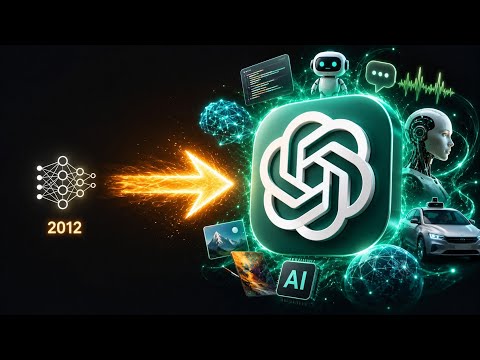
Why AI Suddenly Got So Smart
Description Before ChatGPT, before GPT-4, and before the AI boom, there was one breakthrough that changed everything. In 2012, a neural network called AlexNet achieved something nobody expected and completely transformed the future of artificial intelligence. This single breakthrough reignited AI research, sparked the deep learning revolution, and laid the foundation for the systems that power ChatGPT and modern AI today. In this video, we'll explore: • Why AI struggled for decades • What made AlexNet so different • How it shocked the tech world • Why 2012 became the turning point for AI • How AlexNet ultimately led to ChatGPT The story of modern AI starts here. If you enjoy AI, technology, and fascinating tech history, make sure to subscribe for more videos. #ArtificialIntelligence #AI #ChatGPT #AlexNet #DeepLearning #MachineLearning --- Hashtags #AI #ArtificialIntelligence #ChatGPT #AlexNet #DeepLearning #MachineLearning #NeuralNetworks #AITimeline #Technology #TechHistory #OpenAI #GPT4 #FutureTech #ComputerScience #Innovation --- Search Tags alexnet, alexnet explained, what happened in 2012 ai, ai breakthrough, chatgpt origin, history of ai, deep learning revolution, neural networks explained, artificial intelligence documentary, ai history, machine learning, chatgpt explained, openai, gpt, transformers, modern ai, technology documentary, ai evolution, deep learning explained, alexnet 2012, why 2012 changed ai forever, breakthrough that made chatgpt possible, computer science, future of ai, tech explained, ai revolution, neural network history, ai breakthrough 2012, chatgpt history, artificial intelligence history