Videos de Educación
Videos educativos y de formación.
Educación 184 videos

Day 21 How ChatGPT Really Works: Large Language Models Explained | AI in 5
ChatGPT, Claude, Gemini — they can feel like magic. But at their core, a Large Language Model does ONE simple thing, over and over: it predicts the next token. In Day 21 we finally demystify LLMs, walk through the exact three‑step loop they run, and watch a tiny version of it work for real — using the SAME tokenizer the real GPT models use. You'll learn: what an LLM actually does (predict the next token) • what makes it "large" (huge data + billions of parameters) • the 3 steps: tokenize → predict a probability for every next token → sample → repeat • why it feels intelligent • and why it predicts plausible text rather than truly "knowing." The demo is real and runnable. 0:00 LLMs · 0:41 The one thing an LLM does · 1:20 What makes it 'large' · 2:01 Text → tokens · 2:42 Predict the next token · 3:19 Context in, token out · 3:56 Sample & repeat · 4:36 Watch it for real · 5:10 The code · 5:46 Run it · 6:28 Tokenize·predict·sample·repeat · 7:05 Know its limits · 7:45 Recap Subscribe for a new AI lesson every day. Tomorrow: how LLMs are actually trained. #AI #LLM #ChatGPT

AI That Never Forgets | Dendritron Transformer Explained (The Future of LLMs)
AI That Never Forgets | Dendritron Transformer Explained (The Future of LLMs) What if AI never forgot anything it learned? In this video, we explore the groundbreaking Dendritron Transformer, a next-generation AI architecture designed to overcome one of the biggest limitations of today's Large Language Models (LLMs): catastrophic forgetting. Unlike traditional Transformer models that become static after training, the Dendritron Transformer introduces a bio-inspired internal memory system that enables continuous learning, real-time knowledge updates, and lifelong memory retention without losing previously learned information. If you're interested in Artificial Intelligence, Machine Learning, Deep Learning, Large Language Models (LLMs), AI Agents, Neural Networks, or the future of AI research, this video provides a clear and easy-to-understand explanation of one of the most exciting new AI architectures. 📌 In this video, you'll learn: ✅ What is the Dendritron Transformer? ✅ Why traditional Transformers forget information ✅ What is Catastrophic Forgetting in AI? ✅ How Continuous Learning AI works ✅ Dendritic Computation Explained ✅ Internal Memory vs KV Cache ✅ Lifelong Learning for Large Language Models ✅ Future AI Agents with Persistent Memory ✅ Real-Time Learning in Artificial Intelligence ✅ Applications in Robotics, Healthcare, Finance, Autonomous Systems, and Scientific Research 📚 Colab Notebook: https://colab.research.google.com/drive/1nao2tDffdIThxoH0Nd8_pe_5Gc3JfCZQ?usp=sharing ⭐ If you enjoy videos about Artificial Intelligence, Machine Learning, ChatGPT, OpenAI, Neural Networks, AI Agents, Python, LLMs, Deep Learning, and the latest AI breakthroughs, make sure to Subscribe and turn on notifications so you never miss future videos. 👍 Like the video if you learned something new. 💬 Comment your thoughts about the future of AI memory and continuous learning. • AI News • Machine Learning • Deep Learning • LLM Tutorials • Prompt Engineering • Generative AI • Python for AI • AI Agents • Future Technology #AI #MachineLearning #Dendritron #Transformer #DeepLearning #ContinuousLearning #nlp Dendritron Transformer, AI Memory, Artificial Intelligence, Machine Learning, Deep Learning, Transformer Architecture, Large Language Models, LLM, Continuous Learning, Lifelong Learning, Catastrophic Forgetting, Neural Networks, AI Research, AI Agents, Bio Inspired AI, Real-Time Learning, Future of AI, AI Explained, GPT Alternative, Next Generation AI, AI Architecture, Persistent Memory AI, Memory-Augmented Neural Networks, Cognitive AI, Intelligent Systems #ArtificialIntelligence #MachineLearning #DeepLearning #LLM #Transformer #AI #AIResearch #GenerativeAI #NeuralNetworks #AIAgents #ContinuousLearning #Dendritron #ArtificialGeneralIntelligence #FutureOfAI #AITechnology

GRPO Fine-Tuning with Practical | DeepSeekMath, PPO vs GRPO, Hugging Face & Unsloth
Learn GRPO (Group Relative Policy Optimization) from scratch and fine-tune an LLM using Hugging Face TRL and Unsloth. In this video, we understand how GRPO works, why it was used in DeepSeekMath, how it differs from PPO, and how language models learn from reward signals. We will also implement GRPO fine-tuning practically using Hugging Face and Unsloth. Topics covered in this video: ✅ What is GRPO? ✅ GRPO full form and intuition ✅ Quick background of DeepSeekMath ✅ DeepSeekMath training pipeline ✅ PPO vs GRPO ✅ Problems with the PPO approach ✅ Why GRPO does not require a critic/value model ✅ Group-based reward comparison in GRPO ✅ GRPO step-by-step with a simple example ✅ Reward signal vs reward model ✅ Rule-based and verifiable rewards ✅ Correctness, helpfulness and clarity reward functions ✅ LoRA-based GRPO fine-tuning ✅ GRPO practical using Hugging Face TRL ✅ GRPO practical using Unsloth ✅ Loading and testing the fine-tuned model GRPO stands for Group Relative Policy Optimization. Instead of using a separate value or critic model, GRPO generates multiple answers for the same prompt, compares their rewards within the group and improves the policy using relative performance. This video is useful for machine learning engineers, Generative AI developers, data scientists and anyone learning LLM fine-tuning, reinforcement learning, RLHF, PPO, GRPO, DeepSeek and post-training techniques. Subscribe for more videos on Generative AI, LLM fine-tuning, RAG, Agentic AI, RLHF, PPO and GRPO. Code: https://github.com/sunnysavita10/Complete-LLM-Finetuning/tree/main/LLM%20Fine-Tuning-27-GRPO #GRPO #LLMFineTuning #DeepSeek #HuggingFace #Unsloth 📌 Subscribe for more videos on: LLM Fine-Tuning, RLHF, Quantization, Hugging Face, LangChain, Agentic AI, RAG, AI Systems, and Production-Grade AI Projects. #RLHF #PreferenceAlignment #LLM #PPO #ReinforcementLearning #DPO #ORPO #Qlearning #DQN #LLMFineTuning #GenerativeAI #MachineLearning #SunnySavita #AgenticAI #LangChain #ArtificialIntelligence 📌 Keywords Covered: #MultimodalLLM #VisionLanguageModel #MultimodalFineTuning #LLMFineTuning #Unsloth #LLaVA #QwenVL #Pixtral #LlamaVision #LoRA #QLoRA #VisionEncoder #ProjectionLayer #HuggingFace #Transformers #GenerativeAI #AIForDevelopers #CustomDataset #ImageToText #AITraining #SunnySavita #SemanticSearch #RAG Multimodel RAG Playlist: https://www.youtube.com/watch?v=7CXJWnHI05w&list=PLQxDHpeGU14D6dm0rmAXhdLeLYlX2zk7p&pp=gAQBiAQB RAG detailed playlist: https://www.youtube.com/watch?v=wTVTkOb3SZc&list=PLQxDHpeGU14Blorx3Ps1eZJ4XvKET1_vx&pp=gAQBiAQB GenAI Foundation Playlist: https://www.youtube.com/watch?v=ajWheP8ZD70&list=PLQxDHpeGU14D7NiPgqxC9qhKkx4jMQcDk&pp=gAQBiAQB Connect with me on social media LinkedIn: https://www.linkedin.com/in/sunny-savita/ One-to-One Call: https://topmate.io/sunny_savita10 GitHub: https://github.com/sunnysavita10

Neural Network - How it Works
Neural Network - How it Works 📲 For More Content like this, be sure to Subscribe to our channel! ✅Thanks For Watching: Neural Network - How it Works Here at Thinking Machines, we aim to create top-quality videos about artificial intelligence, machine learning, tech documentaries, AI controversies, big tech developments, robotics, automation, future concepts, and the science shaping tomorrow—covering everything happening in the world of technology and AI. Our goal is to help you understand how AI is changing the world, uncover the stories behind major tech revolutions, and explore the ideas, companies, and breakthroughs building our future. Neural networks learn to recognize patterns by adjusting millions of mathematical connections instead of relying on manually programmed rules. The video explains how raw input data, such as image pixels, flows through layers of neurons that detect increasingly complex features before producing a final prediction. It breaks down key concepts like weights, biases, activation functions, and training in a simple, intuitive way, showing how each component contributes to the network's learning process. You'll also discover why neural networks have become the foundation of modern AI applications, from image recognition and translation to speech processing and self-driving cars. By the end, you'll understand that the power of neural networks comes not from magic or human-like thinking, but from countless simple mathematical operations working together to uncover meaningful patterns. 💻For Business Inquiries, Collaborations or Promotions, contact us at: odedschannel1@gmail.com #neuralnetworks Networks, #artificialintelligence Intelligence, #AI, #machinelearning Learning, Deep Learning, How Neural Networks Work, Neural Network Explained, AI Explained, #aivideo for Beginners, Deep Learning Tutorial, #artificialintelligencetechnology Neural Network, ANN, Weights and Biases, Activation Functions, ReLU, Sigmoid Function, Hidden Layers, Input Layer, Output Layer, Pattern Recognition, Image Recognition, Handwritten Digit Recognition, Computer Vision, AI Training, Backpropagation, Neural Network Training, Parameters, AI Models, Mathematics of AI, Modern AI, Generative AI, Large Language Models, Deep Learning Fundamentals, Data Science, Computer Science, AI Technology, AI Education, #aigenerated Concepts, How AI Learns, Pattern Detection, Predictive Models, Educational Technology, Future of AI, Thinking Machines, Tech Explained, AI Tutorial, Neural Network Basics, Machine Intelligenc

Master RAG in 6 Minutes
# RAG Explained: How AI Retrieves the Right Information Learn **Retrieval-Augmented Generation (RAG)** explained in simple terms. In this beginner-friendly tutorial, you'll understand how RAG works, why **Large Language Models (LLMs)** use it, and how AI systems retrieve relevant information before generating accurate, up-to-date responses. RAG is one of the most important technologies behind modern AI applications. It enables AI assistants to answer questions using external knowledge, documents, databases, and the latest information instead of relying only on what they learned during training. ### In this video, you'll learn: * What is Retrieval-Augmented Generation (RAG)? * Why Large Language Models (LLMs) need RAG * How RAG retrieves relevant information before generating an answer * The complete RAG architecture and workflow explained step by step * Real-world examples of RAG applications * Benefits and limitations of RAG * RAG vs Fine-Tuning: Which approach should you use? Whether you're a student, developer, AI engineer, data scientist, or machine learning enthusiast, this tutorial will help you understand one of the core building blocks of modern AI systems. This video also covers important AI concepts including: * Large Language Models (LLMs) * Generative AI * AI Agents * Vector Databases * Embeddings * Semantic Search * Knowledge Retrieval * Context Augmentation * Prompt Engineering * AI Application Development If you found this video helpful, please Like, Subscribe, and Share it with others who are learning Artificial Intelligence and Machine Learning. Subscribe for more beginner-friendly AI tutorials covering: * AI Agents * Retrieval-Augmented Generation (RAG) * Large Language Models (LLMs) * Model Context Protocol (MCP) * Prompt Engineering * Vector Databases * AI Engineering * Python for AI * Machine Learning * Generative AI * Open Source AI * AI Tools and Tutorials #RAG #AI #LLM

Fundamentos conceptuales de la IA, ¿Qué es un LLM?, ¿Qué puede y qué NO puede garantizar la IA?
Que es un LLM y como funciona realmente la inteligencia artificial que usamos todos los dias? En este video te explicamos, desde cero y sin tecnicismos, los fundamentos de como funciona un modelo de lenguaje como Claude, ChatGPT o Gemini: que puede hacer, que no puede garantizar, y como diferenciarlos entre si. Vas a aprender: - Que es un LLM y por que "predice" texto en lugar de "saber" hechos - Que es un token y una ventana de contexto, explicado con analogias simples - Quien es Anthropic y que hace diferente a Claude de otros asistentes - Que hace bien la IA y que NO deberias confiarle sin verificar - Por que ocurren las alucinaciones y como detectarlas - Vocabulario esencial de IA explicado en simple: prompt, token, fine-tuning y mas Ideal para docentes, estudiantes y cualquier persona que quiera entender la inteligencia artificial de forma critica y responsable, antes de empezar a usarla. Si te sirvio, dale LIKE, SEGUIME y COMPARTI este video para que le llegue a mas personas. #InteligenciaArtificial #IA #ChatGPT #Claude #Educacion #LLM #TecnologiaEducativa #AlfabetizacionDigital

¿Cómo Funciona la Inteligencia Artificial? Explicación Técnica y Fácil (LLMs y Tokens)
Descubre de forma clara, directa y técnica cómo funciona realmente la Inteligencia Artificial Generativa, los modelos de lenguaje (LLMs) y la arquitectura Transformer. En este video explicamos paso a paso qué hay detrás de las herramientas de IA que utilizamos a diario. A lo largo de esta guía técnica pero accesible, analizaremos: La diferencia entre la Inteligencia Artificial tradicional y la IA Generativa. Qué es la arquitectura Transformer y cómo difiere de los modelos de difusión para generación de contenido. El concepto fundamental de Token: la diferencia clave entre cómo leemos los humanos y cómo procesa el texto un modelo de lenguaje. La evolución desde un Modelo Base hasta los modelos tipo Instruct / Chat mediante Fine-Tuning. El funcionamiento de los nuevos Modelos Razonadores y por qué desglosar problemas paso a paso mejora la precisión de las respuestas. El rol imprescindible del cargador de modelos (como Ollama o LM Studio) en la predicción y detención de texto. Por qué los modelos no piensan, no actúan por sí solos ni aprenden en tiempo real sin un proceso de reentrenamiento. Si este contenido te ayuda a comprender mejor el funcionamiento interno de la tecnología actual, asegúrate de darle me gusta al video, dejar tu comentario con tus dudas y suscribirte al canal para más contenido técnico sobre IA y desarrollo. 00:00 Introducción a la IA Generativa 00:32 Concepto de Inteligencia Artificial y evolución 01:30 Arquitecturas de IA: Transformers y Difusión 02:49 Funcionamiento de los LLM: Tokens vs Palabras 04:06 El modelo como predictor del siguiente token 05:58 Diferencia entre autocompletar y responder 06:54 Modelos Base frente a modelos Instruct/Chat 08:29 Introducción a los modelos razonadores 09:33 Funcionamiento del razonamiento paso a paso 12:20 Razonamiento mediante prompts vs modelos nativos 14:43 La naturaleza probabilística de los LLM 17:10 Diferencia entre el modelo y el cargador (Ollama/LM Studio) 18:11 Generación de texto y límites de tokens en modelos base 19:13 Tokens de control en modelos de chat (Usuario/Modelo) 22:09 El rol del cargador en la detención de la respuesta 23:43 Predicción de conversaciones y etiquetas de razonamiento 25:46 Proceso de entrenamiento y actualización de modelos 28:56 Impacto de los ajustes en el rendimiento del modelo 29:43 Resumen de la mecánica de los modelos de lenguaje 30:42 Introducción a los modelos de Difusión 31:31 Aplicaciones y errores comunes en la generación de imágenes 33:36 Entrenamiento de modelos de difusión: Adición y eliminación de ruido 36:24 Concepto de semillas (seeds) y replicabilidad 37:53 Aplicación de la difusión en el audio 38:47 Comparativa: Difusión vs Transformers para generar texto 41:14 Recapitulación técnica de los LLM y cargadores 43:45 Recapitulación técnica de los modelos de Difusión 46:15 Conclusión final #InteligenciaArtificial #IAGenerativa #LLM #ModelosDeLenguaje #Transformers #Ollama #IAExplicada #Prompts #TechSEO #tecnologia como funciona la inteligencia artificial, inteligencia artificial generativa, que es un llm, modelos de lenguaje explicados, que es un token ia, arquitectura transformer, modelos razonadores ia, como funciona chatgpt, ollama explicacion, lm studio tutorial, fine tuning llm, modelo base vs instruct, prediccion de tokens, como funciona la ia generativa, inteligencia artificial tecnica

How AI Turns Pure Noise Into Images — Diffusion Models, Explained Visually
Every AI image generator — Stable Diffusion, DALL·E, Midjourney, even video tools like Sora — works by starting from pure random static and carefully removing noise until a picture appears. This is a visual, from-scratch explanation of how that actually works: diffusion models, built up from one image to the whole idea. We go micro to macro: • Forward diffusion — adding noise to a real image until it's pure static (literally a diffusion process, like ink spreading in water) • Training — the model learns to predict the noise that was added (a single step of a random walk) • Generating — start from static, predict the noise, subtract a little, repeat • Why many tiny steps beat one giant leap • How a text prompt steers every step • The big picture — image space as a map where each point is one whole image, meaningful images are vanishingly rare islands, and noise lets you reach any of them Why it's called "diffusion": add noise to every image and the cloud of all real images spreads out exactly like ink molecules in water — its density obeying the diffusion equation. That's the heart of the name. Everything here is generated from code — the dot simulations are a real, tiny 2D diffusion model; the diagrams and the pixel-space reveal are made from scratch. No stock footage, no licensed tracks. Honest note: the manifold hypothesis (that meaningful images form a thin, low-dimensional set) is strongly supported but not a proven theorem, and the exact shape of those "islands" is still open research. #diffusionmodels #aiart #stablediffusion #machinelearning #generativeai

Cómo se crea un LLM desde cero
🚀 ¿Alguna vez te has preguntado cómo funciona ChatGPT o cómo se crea un modelo de lenguaje desde cero? En Nexis Oaxaca Tech tendremos una charla donde conoceremos los conceptos detrás de los Large Language Models (LLMs), cómo se entrenan y qué tecnologías hacen posible esta revolución en la inteligencia artificial. 🎙️ Ponente: M.C. Carlos Hernández Hernández 📅 10 de julio de 2026 🕓 4:00 PM 💻 Modalidad: Remota No importa si apenas estás empezando o si ya trabajas en tecnología. La idea es aprender, hacer preguntas y seguir construyendo una comunidad donde compartimos conocimiento. En Nexis Oaxaca creemos que el talento existe en Oaxaca; solo necesitamos más espacios para aprender, conectar y crecer juntos. ¡Nos vemos el 10 de julio! 💚💻

How Transformers Actually Work: The Block Behind Every LLM #Shorts
How does a model turn 'the cat sat on the ___' into 'mat'? It looks like magic, but inside it's just one simple block, repeated over and over: the transformer, the engine behind every large language model. A transformer is a tall stack of identical layers. Your text comes in as tokens, each token becomes a vector (a list of numbers), and those vectors flow up through the stack - each layer refining the meaning - until the top produces a prediction for the next token. Each block does two things: (1) attention - every token looks at the tokens before it and pulls in the context that matters (who did what to whom); (2) a feed-forward network - each token is processed on its own to recall facts and patterns. Both are wrapped with a residual connection (a shortcut) and a normalization step so the signal flows cleanly through a very deep stack. Repeat the block dozens of times, and a final layer turns the top vector into probabilities over the whole vocabulary - pick one, and that's your next token. The limits fall out of the design: it predicts one token at a time (autoregressive), attention cost grows with the square of the length (so context windows are capped), and reasoning isn't built in - it emerges from scale. GPT, Claude, Gemini, and Llama are all decoder-only transformers - the same block scaled to billions of parameters - from the 2017 paper 'Attention Is All You Need'. Full lesson (11 free, no signup): https://systemdesign.academy/go/transformer #Transformers #LLM #AI #DeepLearning #Attention #AIEngineering #MachineLearning #SystemDesign #Shorts
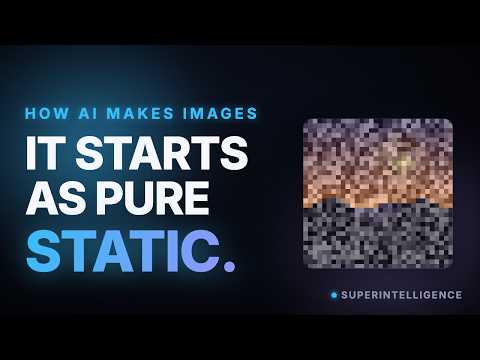
How AI Makes Images From Pure Noise (Diffusion, Explained)
You type a few words and — seconds later — a picture appears that has never existed anywhere in the world. No clip art, no copy-paste, no artist. So how does an AI actually paint something from nothing? The answer is genuinely strange: it doesn't start with a blank canvas. It starts with a screen full of pure random noise — TV static — and removes it. This is the clearest possible explanation of diffusion, the idea behind DALL·E, Midjourney, and Stable Diffusion. No math required. We start with the twist that trips everyone up: image models don't "draw." They begin from a field of random static and, step by step, strip the noise away until a picture that was hiding underneath comes into focus. Creation by removing randomness. Then we unpack how that's even possible: • Trained in reverse. During training the model takes millions of real photos and slowly adds noise to each one, watching it dissolve into static. Do that a billion times and it learns to predict the exact noise that was added at every step. • The whole trick. If you can predict the noise that was added, you can subtract it. So to create a brand-new image, the model just runs the process backwards — from static, back toward a picture. • The denoise loop. Look at the noisy image, predict the noise, subtract a little, repeat — 20 to 50 times — each pass a little sharper, until only the image is left. • What decides the picture? Pure noise could become anything — a face, a forest, a bowl of soup. So your prompt gets turned into numbers the model understands, and at every single denoising step it nudges the guess toward your words. "A sunset over the mountains" pulls the noise, bit by bit, toward exactly that. The mental model to walk away with: the AI is a sculptor, the block of marble is pure noise, and your prompt is the chisel — every step chips a little randomness away until your image is all that remains. Chapters: 0:00 The picture that never existed 0:15 What AI image tools actually do 0:30 The twist: it starts with static 0:52 Watch noise become an image 1:11 How it learned — by destroying images 1:34 Adding noise, step by step 1:51 The trick: predict, then subtract 2:07 Denoising in a loop 2:26 But what decides the picture? 2:45 Your prompt steers every step 3:07 The mental model: a sculptor 3:24 Recap 3:45 Subscribe Making sense of AI, one concept at a time. Subscribe → @watchsuperintelligence #AI #Diffusion #StableDiffusion #Midjourney #DALLE #AIart #GenerativeAI #TextToImage #AIexplained #MachineLearning #ArtificialIntelligence #HowAIWorks