Videos de Educación
Videos educativos y de formación.
Educación 184 videos

Jupyter Notebook desde CERO 📓 | Markdown, HTML, LaTeX y Código Python | Curso Machine Learning 2026
🔥 ¡Bienvenido a la Introducción Práctica de Jupyter Notebook! En este video del Curso de Machine Learning con Python, te enseño todo lo que necesitas saber para comenzar a trabajar en Jupyter Notebook de manera profesional. Aprenderás a crear cuadernos, usar celdas de código y markdown, formatear texto con HTML, crear fórmulas matemáticas con LaTeX, y verificar tus librerías instaladas. ¡Todo lo esencial para tu flujo de trabajo en Data Science! Introducción: ¿Qué es Jupyter Notebook? Abrir Jupyter desde nuestro entorno de trabajo Crear carpetas y organizar el proyecto Crear nuevo cuaderno (notebook) Conociendo el menú y barra de herramientas Celdas: Code vs Markdown Markdown: Texto formateado y Shift+Enter Formatos HTML en Jupyter (h1, alineación) Títulos simplificados con numeral (#) Fórmulas matemáticas con LaTeX y signo de pesos Fracciones en LaTeX: inline vs display Listas con viñetas y numeradas Texto en negritas (**) y cursiva (*) Celdas de código Python: print() y ejecución Comentarios en Python con # Ventaja de Jupyter: Código + Documentación Verificar librerías instaladas (numpy, pandas, matplotlib, sklearn) Imprimir versiones de Python y librerías Explorando el menú File Próximos pasos del curso 📦 LO QUE APRENDERÁS EN ESTE VIDEO: ✅ Crear y organizar notebooks en Jupyter ✅ Diferencia entre celdas Code y Markdown ✅ Formatear texto con HTML (h1, align) ✅ Crear títulos con # (Markdown simplificado) ✅ Escribir fórmulas matemáticas con LaTeX ✅ Listas con viñetas (*) y numeradas (1.) ✅ Texto en negritas **texto** y cursiva *texto* ✅ Ejecutar código Python con Shift+Enter ✅ Comentarios en código con # ✅ Verificar instalaciones: numpy, pandas, matplotlib, sklearn ✅ Imprimir versiones de librerías 💻 CÓDIGO DEL VIDEO: ```python # Verificar librerías instaladas import numpy import pandas import matplotlib import sklearn import sys print("Python:", sys.version) print("Numpy:", numpy.__version__) print("Pandas:", pandas.__version__) print("Matplotlib:", matplotlib.__version__) print("Scikit-Learn:", sklearn.__version__) 💬 COMENTA "JUPYTER" si ya probaste los formatos de markdown 🔔 SUSCRÍBETE para el próximo video: "Introducción a Python - Variables y Tipos de Datos" 🌐 MIS REDES: 📺 YouTube: @AprendamosconScorpionSecurity 📱 TikTok: @scorpionmarcosanchez 📸 Instagram: @scorpionmarcosanchez ☕ ¿Te ayudo a aprender? Apoya el canal: 💰 PayPal: paypal.me/MarcoAntonioS934 📂 CURSO COMPLETO DE MACHINE LEARNING: https://www.youtube.com/playlist?list=PLffixYYr8M_vN46ZZymOB6Wqo4XBTWtiX #JupyterNotebook #Python #MachineLearning #Markdown #DataScience #LaTeX #HTML #CursoPython #Programación #CienciaDeDatos #TutorialPython #ScorpionSecurity #AprendemosConScorpionSecurity #Python2026 #NumPy #Pandas #Matplotlib #ScikitLearn #Notebook
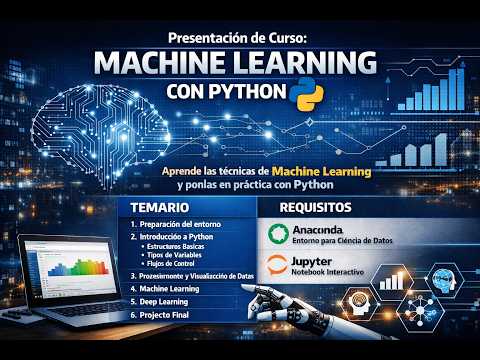
Presentación Curso de Machine Learning con Python 2026 🤖 | De Cero a Proyecto Final
🔥 ¿Quieres dominar la Inteligencia Artificial y crear tus propios modelos predictivos? Este curso PRÁCTICO de Machine Learning con Python te lleva desde los conceptos básicos hasta un Proyecto Final real, sin descuidar la teoría fundamental. 👇 📚 TEMARIO DEL CURSO (Con Marcas de Tiempo): Introducción y qué lograrás en este curso 1. Preparación del entorno: Instalación de Anaconda y Jupyter 2. Introducción a Python (Variables, flujos de control y estructuras) 3. Procesamiento y Visualización de Datos (Librerías, repaso de estadística y matemáticas) 4. Machine Learning: Clasificación y Modelos de Regresión 5. Deep Learning: Redes Neuronales, Perceptrón y Redes Convolucionales 6. PROYECTO FINAL: Aplicando todo lo aprendido en un caso real 💻 REQUISITOS PARA SEGUIR EL CURSO: 1️⃣ Anaconda: Distribución libre para ciencia de datos y cómputo científico. 2️⃣ Jupyter Notebook: Entorno interactivo para integrar código, texto, gráficas e imágenes. 3️⃣ Conocimientos básicos de programación (¡Nosotros te guiamos en el resto!). 💬 COMENTA "ML" en el video y te envío los datasets y el código fuente del Proyecto Final. 🔔 SUSCRÍBETE y activa la campana para no perderte la serie completa de IA y Ciberseguridad. 🌐 CONÉCTATE CONMIGO: 📺 YouTube: @AprendamosconScorpionSecurity 📱 TikTok: @scorpionmarcosanchez 📸 Instagram: @scorpionmarcosanchez ☕ ¿Te ayudo a aprender? Apoya el canal para crear más contenido: 💰 PayPal: paypal.me/MarcoAntonioS934 #MachineLearning #Python #InteligenciaArtificial #DataScience #DeepLearning #CursoDePython #ScorpionSecurity #MachineLearning #Python #InteligenciaArtificial #IA #DataScience #DeepLearning #CursoPython #Anaconda #JupyterNotebook #RedesNeuronales #AprendizajeAutomático #Programación #ScorpionSecurity #AprendemosConScorpionSecurity #Python2026

AI Image Generation MASTERCLASS - Create Stunning Art from Text (6 Steps)
Learn to create professional AI art from text prompts! This masterclass covers everything from beginner basics to advanced techniques. In this tutorial: - Top 3 AI image generators: Midjourney, DALL-E 3, Stable Diffusion - Step 1: Writing effective prompts with the exact formula - Step 2: Style keywords for photorealistic, illustration, painting, 3D - Step 3: Composition and framing with photography terms - Step 4: Advanced prompt engineering (negative prompts, weights, aspect ratios) - Step 5: Iteration and refinement (variations, upscale, inpainting) - Step 6: Practical applications (thumbnails, social media, websites, products) - My #1 tip for beginners Whether you're a marketer, creator, or hobbyist, AI image generation can transform your visual content! Subscribe to Patapo AI for more AI tutorials! 0:00 - Introduction 0:31 - The 3 Best AI Image Tools 1:21 - Step 1: Writing Effective Prompts 2:17 - Step 2: Style Keywords 3:00 - Step 3: Composition & Framing 3:40 - Step 4: Advanced Prompt Engineering 4:24 - Step 5: Iteration & Refinement 5:04 - Step 6: Practical Applications 5:50 - My #1 Tip for Beginners #AIImageGeneration #AITutorial #Midjourney #DALLE3 #PatapoAI #StableDiffusion #AIArt #PromptEngineering #AIImageGen #AIImage #TextToImage #AIArtTutorial #AIForBeginners #PromptTips #AI2026 ━━━━━━━━━━━━━━━━━━━━━━━━━━━━━━━━━━━━━━━━ AFFILIATE LINKS (Support the channel!) ━━━━━━━━━━━━━━━━━━━━━━━━━━━━━━━━━━━━━━━━ ImagineArt - AI Image Generation (50% commission!) https://www.imagine.art/affiliate Canva Pro - AI-Powered Design https://www.canva.com/help/canva-affiliate-marketing-program 10Web - AI Website Builder (30% recurring) https://10web.io Copy.ai - Try Free, Upgrade for More https://affiliates.copy.ai/apply Make - Free Plan Available https://www.make.com/en/affiliate HubSpot - Grow with AI https://www.hubspot.com/partners/affiliates Grammarly Premium - AI Writing https://www.grammarly.com/affiliates Some links above are affiliate links. If you make a purchase, I may earn a commission at no extra cost to you. This helps support the channel and allows me to continue making free content like this. Thank you!

Understanding How NPUs Work - The Heart of AI and Deep Learning Acceleration (9 Minutes)
Understanding How NPUs Work - The Heart of AI and Deep Learning Acceleration provides a comprehensive explanation of neural processing units and their role in powering advanced AI systems. In this video, we delve into the architecture, core functionalities, and how NPUs differ from GPUs and CPUs. Discover how NPUs optimize machine learning, real-time data analysis, and edge computing, transforming industries such as healthcare, automotive, and finance. We explore recent advancements, industry challenges, and future opportunities in NPU technology. Whether you're a developer, researcher, or tech enthusiast, this guide offers valuable insights into how NPUs are shaping the future of intelligent computing. Watch now to understand how these specialized processors accelerate AI performance! 10 SEO-Optimized Hashtags #NPUs #AIHardware #DeepLearning #NeuralProcessingUnits #AIAccelerators #MachineLearningHardware #EdgeAI #HighPerformanceAI #AIProcessing #TechInnovation 35 SEO Tags NPUs explained, neural processing units, AI hardware, deep learning hardware, AI accelerators, edge computing processors, AI chip architecture, machine learning hardware, AI industry trends, high-performance processors, specialized AI chips, AI hardware innovation, neural network acceleration, AI in IoT, AI hardware development, real-time data processing, industry-specific NPUs, AI hardware challenges, next-gen AI processors, AI hardware market, hardware for AI applications, AI chip design, AI hardware future, AI in automotive, healthcare AI hardware, financial AI processing, AI hardware startups, AI performance optimization, industry breakthroughs in NPUs, scalable AI hardware, AI edge devices, AI hardware ecosystem, AI hardware integration, AI technology trends, smart device processing, AI hardware research
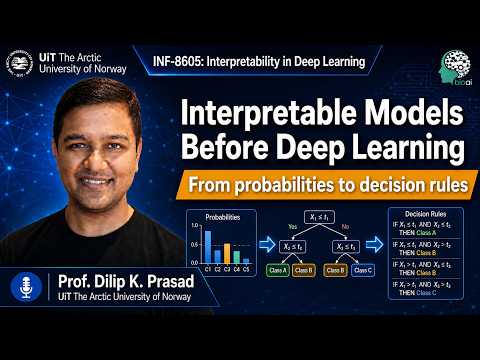
IDL Lect 3C Interpretable Models Before Deep Learning | Feature Importance, Naïve Bayes & Dec. Trees
In this lecture, Prof. Dilip K. Prasad explains how classical machine learning models provided interpretable explanations before deep learning became dominant. The lecture introduces non-graphical explanation methods such as feature importance, probability-based explanations, and decision rules. It discusses why models such as Naïve Bayes, Random Forests, and decision trees are easier to inspect compared with many deep neural networks, and how their structure can help users understand predictions. The lecture also explains important limitations, including why feature importance does not necessarily mean causality and why complex models may require additional explanation tools. It connects classical interpretable models with modern Explainable AI approaches, including surrogate models and other XAI strategies. This lecture is part of a course series on interpretable and explainable artificial intelligence.

Clustering Explained — k-Means, Hierarchical & DBSCAN Visually | Master AI & ML Ep 14
Clustering is where machine learning goes unsupervised — no labels, no correct answers, just data and the question: is there hidden structure here? In this episode we animate k-means from scratch, tackle the deceptively hard problem of choosing k, explore hierarchical clustering and DBSCAN, and confront the hardest question in all of clustering: how do you know if it worked? In this episode: → The unsupervised shift — what changes when there's no target variable → Real use cases: customer segmentation, anomaly detection, document grouping, image compression → k-means step by step — animated convergence from random centroids to stable clusters → Choosing k — the elbow method and silhouette score explained → When k-means fails — elongated clusters and concentric rings → Hierarchical clustering — the dendrogram explained visually → DBSCAN — density-based clustering with built-in outlier detection → Evaluating clustering without ground truth — the hardest problem in unsupervised ML This is Episode 14 of Master AI & Machine Learning — Module 3: Core ML Algorithms, Episode 4 of 6. ────────────────────────────── 📋 FULL COURSE PLAYLIST ⬅ Ep 13 — Decision Trees & Random Forests ➡ Ep 15 — Neural Networks Explained 🌐 TechnovativeAI → www.technovativeai.com ────────────────────────────── ⏱ TIMESTAMPS 00:00 — Hook: the unsupervised shift 00:30 — What clustering is for — real use cases 01:30 — k-means step by step — animated 03:30 — Choosing k — elbow method and silhouette score 04:45 — When k-means fails 05:45 — Hierarchical clustering and DBSCAN 07:00 — How do you evaluate clustering without ground truth? 08:00 — Next episode & CTA ────────────────────────────── Series of Thoughts · Presented by TechnovativeAI #Clustering #kMeans #UnsupervisedLearning #DBSCAN #MachineLearning #MLalgorithms #LearnAI #TechnovativeAI #SeriesOfThoughts #DataScience clustering machine learning, k-means explained, k-means algorithm visual, hierarchical clustering explained, DBSCAN explained, unsupervised learning explained, customer segmentation ML, elbow method k-means, silhouette score explained, clustering without labels, anomaly detection clustering, how k-means works, dendrogram explained, clustering algorithms compared, unsupervised ML tutorial, TechnovativeAI, Series of Thoughts, learn AI, ML algorithm visual, k-means vs DBSCAN

LLMs Explained in 20 Minutes | The Transformer Behind ChatGPT, Gemini & Claude
🚀 LLMs Explained in 10 Minutes | The Transformer Behind ChatGPT, Gemini & Claude Ever wondered how ChatGPT, Gemini, Claude, and other AI assistants actually work? In this video, we'll break down Large Language Models (LLMs) in the simplest way possible. You'll learn how AI evolved from traditional neural networks to the revolutionary Transformer Architecture, the breakthrough that powers modern AI. We'll also explore the Attention Mechanism, the core idea that allows LLMs to understand context, focus on important words, and generate human-like responses. What You'll Learn ✅ What is an LLM (Large Language Model)? ✅ Why RNNs struggled with long context ✅ How Transformer Architecture works ✅ What is the Attention Mechanism? ✅ Why Transformers changed AI forever ✅ How ChatGPT, Gemini, and Claude generate responses ✅ The foundation behind modern Generative AI Whether you're a student, developer, cloud engineer, AI enthusiast, or preparing for AI interviews, this video will help you understand the fundamentals of LLMs without complicated math. 🔥 If you enjoy AI, Generative AI, Agentic AI, Google Cloud, Gemini, MCP, and modern AI architectures, make sure to subscribe for more content. #LLM #ChatGPT #Gemini #Claude #Transformer #GenerativeAI #ArtificialIntelligence #MachineLearning #AIExplained #TechTrapture Playlists Google Agent Development Kit (ADK) https://www.youtube.com/playlist?list=PLLrA_pU9-Gz2HwepRUVpq1TEPuYWo_fSi Learn Airflow https://www.youtube.com/playlist?list=PLLrA_pU9-Gz3i8qw6yakrfJzx75W_vVaH Learn Google Cloud in 2025 https://youtube.com/playlist?list=PLLrA_pU9-Gz2OnBoICkewd9-Fc9Mi0nm7&si=8kkB3ct5wDHCMkoi Data Engineering Hands-on Projects https://www.youtube.com/playlist?list=PLLrA_pU9-Gz2DaQDcY5g9aYczmipBQ_Ek Looking to get in touch? Drop me a line at vishal.bulbule@techtrapture.com Linkedin https://www.linkedin.com/in/vishal-bulbule/ Medium Blog https://medium.com/@VishalBulbule Github Source Code https://github.com/vishal-bulbule

🛡️ REGRESIÓN LOGÍSTICA: Clasificación Inteligente desde cero | Machine Learning | Cap. 11
¡Bienvenidos a un nuevo capítulo del curso "Machine Learning para Todos"! 📘🚀 En lecciones anteriores aprendimos a predecir valores continuos con la Regresión Lineal y a medir sus errores. Pero, ¿qué pasa cuando la pregunta no es "¿cuánto vale?", sino "¿qué es?"? ¿Spam o no spam? ¿Compra o no compra? Hoy entramos de lleno en el mundo de los problemas de Clasificación Binaria. Y para empezar, usaremos el algoritmo fundamental: la Regresión Logística. No dejes que el nombre te engañe; aunque dice "regresión", su superpoder es clasificar. En este vídeo desglosaremos la lógica matemática (la función sigmoide 📉), entenderemos cómo funciona la probabilidad y lo implementaremos paso a paso en Python usando nuestra herramienta favorita, Scikit-Learn. Saber clasificar datos es el primer gran paso para crear IAs que tomen decisiones reales. ¡No te lo pierdas! 🧠⚡ Puedes acceder al libro publicado en Amazon, desde aqui: https://www.amazon.es/dp/B0CW17NBGM Conviértete en miembro de este canal para disfrutar de ventajas: https://www.youtube.com/channel/UCXk7hdEZ7JxauhESxwKJadw/join Tambien puedes visitar mi repositorio GitHub - https://github.com/josecodetech Y no olvides seguirme en las principales redes: Twitter - https://twitter.com/josecodetech BlueSky - https://bsky.app/profile/josecodetech.bsky.social Instagram - https://www.instagram.com/josecodetech Facebook - https://www.facebook.com/josecodetech/ Tik-tok - https://www.tiktok.com/@joseojedarojas #josecodetech #programacion #desarrollo #formacion

How LLMs Understand your Prompts: Tokenization & Embeddings | Chapter 05
What are vector embeddings and tokenization, and how do they let an LLM understand meaning? This video explains tokenization, embeddings, vector dimensions, cosine similarity and positional embeddings - with a hands-on coding demo. ===== In this video, you will learn ===== • What tokenization is and the main types of tokenizers (incl. Byte Pair Encoding) • What vector embeddings are, and what vectors & dimensions actually mean • How an LLM captures meaning using embeddings • How cosine similarity measures how "close" two pieces of text are • Positional embeddings - how models know word order • A hands-on Python demo: tokenizer + embeddings in code This is Part 5 of the GenAI Fundamentals series - for data engineers, developers, and anyone learning how AI language models actually work. ===== Chapters ===== 00:00 - Introduction 00:32 - What is Tokenization and Vector Embeddings? 03:41 - What are Vectors and Dimensions? 06:37 - Why Vectors matter for LLMs? 07:59 - How meaning is captured using Embedding? 12:30 - What is Cosine Similarity? 14:08 - Types of Tokenizers 17:50 - (Hands on) Coding for Tokenizer and Embeddings 26:48 - What are Positional Embeddings? ===== Links ===== Google's "Attention is all You Need" Paper - https://arxiv.org/pdf/1706.03762 Groq Cloud - https://console.groq.com/home GPT Tokenizer - https://platform.openai.com/tokenizer Google Collab - https://colab.research.google.com/ Byte Pair Encoding (BPE) - https://www.geeksforgeeks.org/nlp/byte-pair-encoding-bpe-in-nlp/ Github Code - https://github.com/subhamkharwal/genai-for-data-engineers/blob/master/codes/genai_chap05.ipynb ===== Other Playlists ===== Checkout all other playlists on Data Engineering 👇🏻 https://www.youtube.com/@easewithdata/playlists ===== GitHub Repo ===== https://github.com/subhamkharwal https://github.com/subhamkharwal/genai-for-data-engineers ===== Connect with ME ===== LinkedIn - https://www.linkedin.com/in/subhamkharwal Medium - https://subhamkharwal.medium.com ===== Hashtags ===== #VectorEmbeddings #Tokenization #LLM #GenerativeAI #genai #dataengineering #python #neuralnetworks #machinelearning

How to Build an LLM From Scratch in PyTorch
I implemented a Transformer/LLM from scratch in PyTorch and trained it as a small GPT like language model. The goal of this video is to understand how modern LLMs work under the hood by implementing a language model from scratch, inspired by the Attention Is All You Need paper. We start with the dataset and tokenization, then build embeddings, positional encoding, masked multi head attention, decoder blocks, and the full PyTorch training loop.This is a decoder only Transformer trained with next token prediction, similar in spirit to GPT. For the dataset I use Yu Gi Oh cards, which makes the final output a bit more fun than another Shakespeare example. Code: https://github.com/vossenwout/llm-from-scratch Paper: https://arxiv.org/abs/1706.03762 Timestamps: 00:00 - Building a Transformer from Scratch in PyTorch 01:15 - Why train on Yu-Gi-Oh cards? 03:05 - Downloading and preprocessing the dataset 08:25 - Building tokenizers for our language model 12:40 - Byte Pair Encoding tokenizer explained 19:15 - Creating a PyTorch dataset 20:35 - Next-token prediction explained 21:45 - Transformer input and output shapes 27:40 - Decoder-only Transformers explained 30:55 - Token embeddings and positional encoding 39:10 - Implementing the Transformer decoder 41:30 - Multi-head attention explained 49:40 - Causal masking for GPT-style models 57:05 - Implementing multi-head attention in PyTorch 1:00:20 - Optimizing attention (vectorization) 1:05:00 - Residual connections, dropout, and layer norm 1:09:25 - Feed-forward networks in Transformers 1:13:25 - Stacking decoder blocks 1:16:40 - Building the PyTorch training loop 1:21:35 - Cross entropy loss and optimization 1:29:50 - Validation loss, perplexity, and checkpoints 1:32:00 - Training the Transformer model 1:34:25 - Training results and overfitting 1:35:45 - Building the inference script 1:38:45 - Sampling tokens with temperature 1:41:20 - Generating AI Yu-Gi-Oh cards 1:44:00 - Opening AI-generated booster packs 1:48:30 - Final thoughts #pytorch #llm #deeplearning

Day - 03 : GEN AI + LLM + RAG + Agentic AI Overview by Mr. Ashok
Artificial Intelligence is changing the way software applications are built. In this session, Mr. Ashok explains the most important AI concepts every student and developer should know. In this video, you will learn: ✅ What is Generative AI? ✅ What are Large Language Models? ✅ How RAG works in real-time applications ✅ What is Agentic AI? ✅ Difference between LLM, RAG, and AI Agents ✅ Real-world use cases of Gen AI ✅ Career opportunities in AI This session is useful for students, freshers, working professionals, Java developers, Python developers, and anyone who wants to start learning AI from basics. 📌 Watch the full session and start your AI learning journey today. #GenAI #LLM #RAG #AgenticAI #ArtificialIntelligence #AIOverview #GenerativeAI #PromptEngineering #AIForBeginners #AshokIT #MrAshok #PythonAI #AICareer #MachineLearning #TechLearning

11. Variational Autoencoders (VAEs) Explained Clearly | From Basics to Latent Space & KL Divergence
Variational Autoencoders (VAEs) are one of the most important concepts in modern deep learning and generative AI. In this video, you will learn how VAEs work from first principles—without confusion, fluff, or unnecessary complexity. We begin by revisiting traditional autoencoders and identifying their limitations in generative tasks. Then, we build a strong conceptual understanding of VAEs, including probabilistic encoding, latent space representation, and the powerful idea of learning data distributions instead of fixed mappings. This video explains key concepts such as: The difference between autoencoders and variational autoencoders Why VAEs model latent variables as probability distributions The role of mean (μ) and standard deviation (σ) The reparameterization trick and why it is essential Understanding KL Divergence in a simple and intuitive way How VAEs enable data generation, interpolation, and representation learning Real-world applications in AI, including image generation, anomaly detection, and healthcare By the end of this video, you will have a clear, intuitive, and practical understanding of VAEs, making it easier to implement and apply them in research or real-world AI systems. This content is especially useful for: Students and researchers in Machine Learning and AI Data Scientists and Deep Learning practitioners Anyone preparing for interviews or academic projects in generative models 🚀 What You’ll Learn ✔ Variational Autoencoders (VAEs) from scratch ✔ Latent space and probabilistic modeling ✔ Mathematical intuition behind KL divergence ✔ Differences between VAEs and GANs ✔ Applications of VAEs in modern AI 📌 Why This Topic Matters VAEs are foundational to many advanced generative models and are widely used in fields like computer vision, NLP, healthcare AI, and scientific simulations. Understanding VAEs gives you a strong edge in mastering generative AI systems. ⚠️ Disclaimer This video is created purely for educational and knowledge-building purposes. The content is AI-generated, and while efforts have been made to ensure accuracy, some information may be incomplete or incorrect. Viewers are encouraged to verify facts and concepts from reliable sources before applying them in academic or professional work. #VariationalAutoencoder #VAE #DeepLearning #GenerativeAI #MachineLearning #LatentSpace #ArtificialIntelligence #NeuralNetworks #AIExplained #DataScience #KLdivergence #Autoencoder #AIeducation #LearnAI #TechEducation Variational Autoencoder, VAE explained, VAE tutorial, deep learning VAE, generative AI models, autoencoder vs VAE, KL divergence explained, latent space machine learning, probabilistic models AI, reparameterization trick, neural networks tutorial, AI for beginners, advanced machine learning, generative models explained, data science AI concepts, VAE applications, AI education content, machine learning lecture, NotebookLM AI video, deep learning concepts 2026