Videos de machine learning
Videos etiquetados con "machine learning"
machine learning 66 videos

Google Gemini 3.5 Pro Explained | 2M Tokens, Deep Think & GPT-6 Comparison
Link to our newsletter: https://bitbiased.ai/ Google's Gemini 3.5 Pro is rumored to launch with a massive 2 million token context window, a new Deep Think reasoning mode, and significantly cheaper API pricing. But are these leaks actually as groundbreaking as everyone claims? In this video, we break down: ✅ Gemini 3.5 Pro leaks explained ✅ 2 Million Token Context Window ✅ Deep Think reasoning mode ✅ API pricing and why it matters ✅ Gemini 3.5 Pro vs GPT-6 ✅ Gemini 3.5 Pro vs Claude Fable 5.1 ✅ Google AI strategy in 2026 ✅ What actually deserves the hype Instead of repeating AI rumors, this video separates confirmed information from speculation and explains what Google's strategy could mean for developers, businesses, and AI enthusiasts. If you're following GPT-6, OpenAI, Google DeepMind, Anthropic, Claude, or the future of generative AI, this video is for you. Timestamps 00:00 Introduction 01:23 What's Actually Being Claimed 02:48 The Two Million Tokens Everyone's Chasing 04:54 The Price Is The Real Story 06:55 Deep Think & The Paywall 08:37 Gemini 3.5 Pro vs GPT-6 & Claude Fable 5.1 10:43 What Would Actually Earn The Hype 12:21 Final Thoughts Subscribe for weekly AI news, model comparisons, benchmark analysis, and practical insights. #Gemini35Pro #googleai #gpt6 #openai #artificialintelligence #deepthinking #ai #claude #googledeepmind #machinelearning

The AI That's Quietly Replacing Millions of Jobs (And Most People Don't Notice)
What if AI isn't replacing jobs the way you think? While most people imagine robots taking over factories, today's AI is transforming offices, spreadsheets, customer service, and even white-collar work—often without anyone noticing. Instead of dramatic layoffs, many companies are simply hiring fewer people as AI takes over routine tasks. In this documentary-style video, we explore: * How automation evolved from factory robots to generative AI * Why AI is changing the job market faster than ever * Which careers are most at risk * Why entry-level jobs are disappearing * The new opportunities AI is creating * How to prepare for the future of work Based on research from the World Economic Forum, labor market reports, and academic studies, this video separates hype from reality and explains what the AI revolution really means for your career. If you're interested in AI, future technology, automation, business, economics, and the future of work, subscribe to FUTURECTH for weekly documentary-style videos exploring the technologies shaping tomorrow. **Disclaimer:** This video is created for educational and informational purposes. Visuals may include licensed stock footage and AI-generated illustrations. All trademarks and copyrighted materials belong to their respective owners. #AI #ArtificialIntelligence #FutureOfWork #Automation #FutureTech #Technology #Jobs #Career #Business #Productivity #GenerativeAI #MachineLearning #OfficeJobs #Innovation #FUTURECTH

AI That Never Forgets | Dendritron Transformer Explained (The Future of LLMs)
AI That Never Forgets | Dendritron Transformer Explained (The Future of LLMs) What if AI never forgot anything it learned? In this video, we explore the groundbreaking Dendritron Transformer, a next-generation AI architecture designed to overcome one of the biggest limitations of today's Large Language Models (LLMs): catastrophic forgetting. Unlike traditional Transformer models that become static after training, the Dendritron Transformer introduces a bio-inspired internal memory system that enables continuous learning, real-time knowledge updates, and lifelong memory retention without losing previously learned information. If you're interested in Artificial Intelligence, Machine Learning, Deep Learning, Large Language Models (LLMs), AI Agents, Neural Networks, or the future of AI research, this video provides a clear and easy-to-understand explanation of one of the most exciting new AI architectures. 📌 In this video, you'll learn: ✅ What is the Dendritron Transformer? ✅ Why traditional Transformers forget information ✅ What is Catastrophic Forgetting in AI? ✅ How Continuous Learning AI works ✅ Dendritic Computation Explained ✅ Internal Memory vs KV Cache ✅ Lifelong Learning for Large Language Models ✅ Future AI Agents with Persistent Memory ✅ Real-Time Learning in Artificial Intelligence ✅ Applications in Robotics, Healthcare, Finance, Autonomous Systems, and Scientific Research 📚 Colab Notebook: https://colab.research.google.com/drive/1nao2tDffdIThxoH0Nd8_pe_5Gc3JfCZQ?usp=sharing ⭐ If you enjoy videos about Artificial Intelligence, Machine Learning, ChatGPT, OpenAI, Neural Networks, AI Agents, Python, LLMs, Deep Learning, and the latest AI breakthroughs, make sure to Subscribe and turn on notifications so you never miss future videos. 👍 Like the video if you learned something new. 💬 Comment your thoughts about the future of AI memory and continuous learning. • AI News • Machine Learning • Deep Learning • LLM Tutorials • Prompt Engineering • Generative AI • Python for AI • AI Agents • Future Technology #AI #MachineLearning #Dendritron #Transformer #DeepLearning #ContinuousLearning #nlp Dendritron Transformer, AI Memory, Artificial Intelligence, Machine Learning, Deep Learning, Transformer Architecture, Large Language Models, LLM, Continuous Learning, Lifelong Learning, Catastrophic Forgetting, Neural Networks, AI Research, AI Agents, Bio Inspired AI, Real-Time Learning, Future of AI, AI Explained, GPT Alternative, Next Generation AI, AI Architecture, Persistent Memory AI, Memory-Augmented Neural Networks, Cognitive AI, Intelligent Systems #ArtificialIntelligence #MachineLearning #DeepLearning #LLM #Transformer #AI #AIResearch #GenerativeAI #NeuralNetworks #AIAgents #ContinuousLearning #Dendritron #ArtificialGeneralIntelligence #FutureOfAI #AITechnology

Neural Network - How it Works
Neural Network - How it Works 📲 For More Content like this, be sure to Subscribe to our channel! ✅Thanks For Watching: Neural Network - How it Works Here at Thinking Machines, we aim to create top-quality videos about artificial intelligence, machine learning, tech documentaries, AI controversies, big tech developments, robotics, automation, future concepts, and the science shaping tomorrow—covering everything happening in the world of technology and AI. Our goal is to help you understand how AI is changing the world, uncover the stories behind major tech revolutions, and explore the ideas, companies, and breakthroughs building our future. Neural networks learn to recognize patterns by adjusting millions of mathematical connections instead of relying on manually programmed rules. The video explains how raw input data, such as image pixels, flows through layers of neurons that detect increasingly complex features before producing a final prediction. It breaks down key concepts like weights, biases, activation functions, and training in a simple, intuitive way, showing how each component contributes to the network's learning process. You'll also discover why neural networks have become the foundation of modern AI applications, from image recognition and translation to speech processing and self-driving cars. By the end, you'll understand that the power of neural networks comes not from magic or human-like thinking, but from countless simple mathematical operations working together to uncover meaningful patterns. 💻For Business Inquiries, Collaborations or Promotions, contact us at: odedschannel1@gmail.com #neuralnetworks Networks, #artificialintelligence Intelligence, #AI, #machinelearning Learning, Deep Learning, How Neural Networks Work, Neural Network Explained, AI Explained, #aivideo for Beginners, Deep Learning Tutorial, #artificialintelligencetechnology Neural Network, ANN, Weights and Biases, Activation Functions, ReLU, Sigmoid Function, Hidden Layers, Input Layer, Output Layer, Pattern Recognition, Image Recognition, Handwritten Digit Recognition, Computer Vision, AI Training, Backpropagation, Neural Network Training, Parameters, AI Models, Mathematics of AI, Modern AI, Generative AI, Large Language Models, Deep Learning Fundamentals, Data Science, Computer Science, AI Technology, AI Education, #aigenerated Concepts, How AI Learns, Pattern Detection, Predictive Models, Educational Technology, Future of AI, Thinking Machines, Tech Explained, AI Tutorial, Neural Network Basics, Machine Intelligenc

Master RAG in 6 Minutes
# RAG Explained: How AI Retrieves the Right Information Learn **Retrieval-Augmented Generation (RAG)** explained in simple terms. In this beginner-friendly tutorial, you'll understand how RAG works, why **Large Language Models (LLMs)** use it, and how AI systems retrieve relevant information before generating accurate, up-to-date responses. RAG is one of the most important technologies behind modern AI applications. It enables AI assistants to answer questions using external knowledge, documents, databases, and the latest information instead of relying only on what they learned during training. ### In this video, you'll learn: * What is Retrieval-Augmented Generation (RAG)? * Why Large Language Models (LLMs) need RAG * How RAG retrieves relevant information before generating an answer * The complete RAG architecture and workflow explained step by step * Real-world examples of RAG applications * Benefits and limitations of RAG * RAG vs Fine-Tuning: Which approach should you use? Whether you're a student, developer, AI engineer, data scientist, or machine learning enthusiast, this tutorial will help you understand one of the core building blocks of modern AI systems. This video also covers important AI concepts including: * Large Language Models (LLMs) * Generative AI * AI Agents * Vector Databases * Embeddings * Semantic Search * Knowledge Retrieval * Context Augmentation * Prompt Engineering * AI Application Development If you found this video helpful, please Like, Subscribe, and Share it with others who are learning Artificial Intelligence and Machine Learning. Subscribe for more beginner-friendly AI tutorials covering: * AI Agents * Retrieval-Augmented Generation (RAG) * Large Language Models (LLMs) * Model Context Protocol (MCP) * Prompt Engineering * Vector Databases * AI Engineering * Python for AI * Machine Learning * Generative AI * Open Source AI * AI Tools and Tutorials #RAG #AI #LLM

🤖 Ya Hay ROBOTS Más BARATOS Que Tú...
⚙️ ¿Qué pasará cuando un robot sea más barato que contratar a una persona? 💼 ¿Estamos cerca del mayor cambio en la historia del trabajo y la automatización? 🚀 ¿Será la inteligencia artificial una oportunidad para la humanidad... o el inicio de una nueva revolución laboral? En este impactante documental exploramos cómo la caída en el costo de los robots humanoides, la inteligencia artificial y la automatización están transformando la economía mundial. Descubre por qué cada vez más empresas están reemplazando tareas humanas por máquinas inteligentes y cómo esta revolución podría cambiar el empleo, los salarios y la forma en que trabajaremos durante los próximos años. Analizamos el avance de la robótica, la reducción de los costos de producción, los nuevos empleos que surgirán y las habilidades que serán más valiosas en un mundo donde humanos y máquinas convivirán cada vez más. 🔍 En este documental descubrirás: ✅ Cuándo los robots podrían costar menos que un trabajador. ✅ Cómo la inteligencia artificial está acelerando la automatización. ✅ Qué empleos tienen mayor riesgo de ser reemplazados. ✅ Las nuevas profesiones que surgirán gracias a la robótica. ✅ Cómo la tecnología está cambiando la economía mundial. ✅ Los beneficios y riesgos de una sociedad automatizada. ✅ Qué habilidades serán esenciales para el futuro del trabajo. ✅ Cómo prepararte para la próxima revolución tecnológica. Si te apasionan los temas de inteligencia artificial, robótica, automatización, tecnología, economía, innovación, empleo, futuro del trabajo, robots humanoides, ciencia y transformación digital, este video es para ti. 💬 Déjanos tu opinión en los comentarios: ¿Crees que los robots reemplazarán la mayoría de los empleos o que crearán nuevas oportunidades para las personas? 👍 Si disfrutaste este documental, deja tu LIKE, SUSCRÍBETE y activa la 🔔 para descubrir más documentales sobre inteligencia artificial, robótica, ciencia y las tecnologías que están construyendo el futuro. ━━━━━━━━━━━━━━━━━━━━━━━━━━━━━━ Temas del documental: robots, inteligencia artificial, automatización, robots humanoides, futuro del trabajo, empleo, tecnología, economía, innovación, robótica, transformación digital, automatización laboral, salarios, industria 4.0, productividad, ciencia, futuro, documentales de tecnología. #Robots #InteligenciaArtificial #Automatización #Tecnología #FuturoDelTrabajo #Robótica #Innovación #Economía #Documental #LaPróximaEra ════════════════════════════════════════════ LA PRÓXIMA ERA ════════════════════════════════════════════ En La Próxima Era, exploramos el futuro de la humanidad a través de la inteligencia artificial, la tecnología, la ciencia, la innovación, la robótica, la computación cuántica, la exploración espacial, la automatización, la economía tecnológica y las tendencias que están transformando el mundo. Nuestro contenido combina investigación, análisis, divulgación científica y pensamiento crítico para explicar de forma clara cómo los avances tecnológicos impactarán nuestra sociedad, nuestra economía y nuestra vida cotidiana. Todo el contenido publicado en este canal tiene un propósito exclusivamente educativo, informativo y divulgativo. Nuestro objetivo es acercar al público a temas complejos mediante explicaciones accesibles, análisis basados en evidencia y una visión objetiva sobre el desarrollo tecnológico y científico. La información presentada no constituye asesoramiento profesional, científico, médico, legal, financiero, tecnológico o de inversión. Las referencias a inteligencia artificial, automatización, empresas tecnológicas, modelos de negocio, descubrimientos científicos, investigaciones, escenarios futuros o avances tecnológicos tienen fines exclusivamente educativos y no deben interpretarse como recomendaciones profesionales o predicciones absolutas. ════════════════════════════════════════════ DISCLAIMER ════════════════════════════════════════════ La Próxima Era es un canal dedicado a la divulgación científica, tecnológica y educativa. Los temas relacionados con inteligencia artificial, aprendizaje automático, robótica, computación cuántica, exploración espacial, automatización, innovación, biotecnología, ciberseguridad, economía digital, empresas tecnológicas y tecnologías emergentes se presentan únicamente con fines informativos, analíticos y de entretenimiento educativo. Este canal no promueve desinformación, teorías conspirativas, prácticas ilegales, manipulación tecnológica, actividades fraudulentas, uso indebido de inteligencia artificial ni cualquier acción que pueda vulnerar la privacidad, la seguridad o la legislación vigente. Las referencias a investigaciones científicas, empresas tecnológicas, productos, herramientas de inteligencia artificial, modelos predictivos, patentes, descubrimientos, estudios académicos o desarrollos tecnológicos se utilizan como material de análisis y divulgación o garantía sobre el rendimiento de productos, empresas o tecnologías.

Google Eliminó Gemini CLI... ¿Quién Será el Siguiente? La Verdad Detrás del Caos
¿Google está perdiendo la carrera de la inteligencia artificial o simplemente está perdiendo la confianza de los desarrolladores? En este video analizamos el polémico fin de Gemini CLI, la llegada de Antigravity, los cambios en los límites de uso de Gemini, la inversión récord de Google en IA y por qué miles de programadores reaccionaron con frustración durante Google I/O 2026. Descubre qué ocurrió realmente, por qué tantos usuarios están migrando a otras herramientas de IA y qué significa todo esto para el futuro del desarrollo de software con inteligencia artificial. Si te interesan temas como Google AI, Gemini, Gemini CLI, Antigravity, Google I/O, Claude Code, OpenAI, Cursor AI, GitHub Copilot, programación con IA, agentes de IA, desarrollo de software, LLMs, IA generativa y las últimas noticias sobre inteligencia artificial, este video es para ti. ⏱️ Capítulos 00:00 ¿Qué pasó con Google? 00:48 La mejor semana de Google... y su mayor polémica 02:02 El cambio de límites de Gemini que enfureció a los usuarios 03:15 Google elimina Gemini CLI y presenta Antigravity 04:32 El editor que desapareció de la noche a la mañana 05:45 ¿Por qué Google reaccionó tan rápido? 06:37 La nueva realidad del negocio de la IA 07:28 ¿Google realmente está perdiendo la carrera de la IA? 08:30 El verdadero problema: la confianza de los desarrolladores 09:30 ¿Qué viene ahora para Google AI y Gemini? En este canal analizamos cada semana las noticias más importantes sobre Inteligencia Artificial, ChatGPT, OpenAI, Google Gemini, Claude, Anthropic, DeepSeek, Meta AI, LLMs, agentes de IA, programación asistida por IA y las tecnologías que están transformando el desarrollo de software. 💬 ¿Crees que Google cometió un error al eliminar Gemini CLI? ¿Confiarías tu trabajo diario a una plataforma que cambia constantemente? Déjalo en los comentarios. 👍 Si te gustó este análisis, suscríbete y activa la campana para no perderte los próximos videos sobre inteligencia artificial, programación y las últimas novedades del mundo de la IA. #GoogleAI #Gemini #GeminiCLI #Antigravity #GoogleIO #InteligenciaArtificial #IA #Programacion #DesarrolloDeSoftware #Claude #OpenAI #CursorAI #GitHubCopilot #LLM #AIAgents
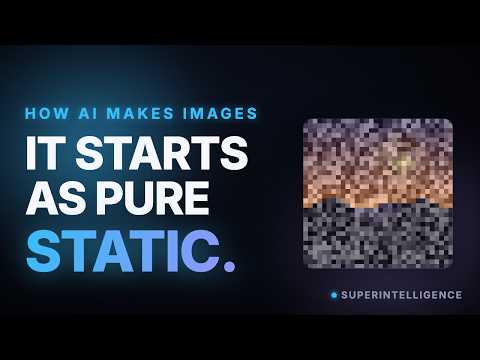
How AI Makes Images From Pure Noise (Diffusion, Explained)
You type a few words and — seconds later — a picture appears that has never existed anywhere in the world. No clip art, no copy-paste, no artist. So how does an AI actually paint something from nothing? The answer is genuinely strange: it doesn't start with a blank canvas. It starts with a screen full of pure random noise — TV static — and removes it. This is the clearest possible explanation of diffusion, the idea behind DALL·E, Midjourney, and Stable Diffusion. No math required. We start with the twist that trips everyone up: image models don't "draw." They begin from a field of random static and, step by step, strip the noise away until a picture that was hiding underneath comes into focus. Creation by removing randomness. Then we unpack how that's even possible: • Trained in reverse. During training the model takes millions of real photos and slowly adds noise to each one, watching it dissolve into static. Do that a billion times and it learns to predict the exact noise that was added at every step. • The whole trick. If you can predict the noise that was added, you can subtract it. So to create a brand-new image, the model just runs the process backwards — from static, back toward a picture. • The denoise loop. Look at the noisy image, predict the noise, subtract a little, repeat — 20 to 50 times — each pass a little sharper, until only the image is left. • What decides the picture? Pure noise could become anything — a face, a forest, a bowl of soup. So your prompt gets turned into numbers the model understands, and at every single denoising step it nudges the guess toward your words. "A sunset over the mountains" pulls the noise, bit by bit, toward exactly that. The mental model to walk away with: the AI is a sculptor, the block of marble is pure noise, and your prompt is the chisel — every step chips a little randomness away until your image is all that remains. Chapters: 0:00 The picture that never existed 0:15 What AI image tools actually do 0:30 The twist: it starts with static 0:52 Watch noise become an image 1:11 How it learned — by destroying images 1:34 Adding noise, step by step 1:51 The trick: predict, then subtract 2:07 Denoising in a loop 2:26 But what decides the picture? 2:45 Your prompt steers every step 3:07 The mental model: a sculptor 3:24 Recap 3:45 Subscribe Making sense of AI, one concept at a time. Subscribe → @watchsuperintelligence #AI #Diffusion #StableDiffusion #Midjourney #DALLE #AIart #GenerativeAI #TextToImage #AIexplained #MachineLearning #ArtificialIntelligence #HowAIWorks

What is a Neural Network? | Neural Network Explained for Beginners | @quicklearnerss
🧠 Neural Networks are the foundation of modern Artificial Intelligence, Machine Learning, and Deep Learning. In this beginner-friendly tutorial, you'll learn how Artificial Neural Networks (ANN) work using simple language, real-life examples, and easy-to-understand animations. Whether you're a Computer Science student, engineering student, AI enthusiast, or preparing for placements and interviews, this video will help you understand Neural Networks from scratch. 📌 In this video, you'll learn: ✔ What is a Neural Network? ✔ Why Neural Networks are important? ✔ Biological Neuron vs Artificial Neuron ✔ Structure of an Artificial Neural Network ✔ Input Layer, Hidden Layer & Output Layer ✔ Weights, Bias, and Activation Function ✔ Feed Forward Process ✔ Training a Neural Network ✔ Backpropagation (Basic Introduction) ✔ Real-life Applications of Neural Networks 🎯 This video is perfect for: • B.Tech / BCA / MCA Students • AI & Machine Learning Beginners • Deep Learning Beginners • Placement Preparation • University Exam Preparation • GATE Aspirants • Anyone curious about Artificial Intelligence ━━━━━━━━━━━━━━━━━━━━ 📚 Prerequisites: Basic understanding of mathematics is helpful but not required. ━━━━━━━━━━━━━━━━━━━━ 🔥 Related Videos: ▶ Artificial Intelligence Complete Playlist ▶ Machine Learning for Beginners ▶ Deep Learning Tutorial ▶ Perceptron Explained ▶ Activation Functions Explained ▶ Machine Learning Roadmap ━━━━━━━━━━━━━━━━━━━━ 💻 Technologies Discussed: Artificial Intelligence Machine Learning Deep Learning Artificial Neural Networks Perceptron Activation Functions Backpropagation ━━━━━━━━━━━━━━━━━━━━ 👍 If you found this video helpful: ✔ Like the video ✔ Share it with your friends ✔ Subscribe for more AI and Computer Science tutorials ✔ Turn on the notification bell 🔔 #NeuralNetwork #ArtificialIntelligence #MachineLearning #DeepLearning #AI #ANN #DataScience #ComputerScience #AIForBeginners #DeepLearningTutorial

The Perceptron: All of AI Is One Neuron
Try it yourself. The full written explainer and an interactive perceptron you can click are here: https://unrote.com/ai/the-perceptron/ The perceptron is a single artificial neuron, and it is the atom that every neural network is built from. In this from-scratch explainer we build one step by step: the inputs, the weights, the weighted sum, the bias, and the activation that makes it fire. Then we watch what one neuron can do, draw a straight line to separate data, meet the famous pattern it cannot solve (XOR), and see how stacking neurons into layers turns them into deep learning. What you will understand by the end: - What a neuron actually takes in, and why each input is a number - Weights: how much each piece of evidence counts - The weighted sum and the bias, in plain terms - Activation: the step function that outputs a one or a zero - A worked decision, start to finish - How a perceptron learns its weights - One straight line, and the hard limit of a single neuron - Why stacking neurons into layers gives you a neural network Understand it, don't memorize it.

¿La IA en medicina es real? Opus 4.8 revela el futuro del diagnóstico
17 segundos fue lo que tardó Opus 4.8 en analizar una resonancia magnética, revelando hallazgos que los expertos médicos tardarían horas en procesar. La inteligencia artificial ha prometido revolucionar la medicina por años, pero el reciente experimento con Opus 4.8 analizando una resonancia magnética marca un antes y un después. Este suceso no solo valida la capacidad diagnóstica de los modelos de IA avanzados, sino que plantea preguntas cruciales sobre el rol humano en la salud, la ética y la velocidad de los avances tecnológicos. Entenderás qué implica para tu futuro médico y cómo afectará la atención sanitaria global. 🤖 EN ESTE VÍDEO: ✅ Cómo Opus 4.8 procesó la resonancia magnética y qué anomalías detectó ✅ La precisión sorprendente de la IA frente al diagnóstico médico tradicional ✅ Implicaciones éticas y el debate sobre la autonomía de la IA en salud ✅ Qué significa este avance para el futuro de tu atención médica ✅ Por qué este modelo de Anthropic supera a otros en razonamiento contextual Este hito con Opus 4.8 redefine la frontera entre IA y medicina, abriendo un abanico de posibilidades y desafíos. ¿Estás listo para confiar tu salud a un algoritmo? Suscríbete a MYBESTIA para no perderte las últimas novedades y déjanos tu opinión: ¿Crees que la IA debería tener la última palabra en diagnósticos médicos? ▬▬▬▬▬▬▬▬▬▬▬▬▬▬▬▬▬▬▬▬▬▬▬▬▬▬▬▬▬▬▬▬ 🔔 SUSCRÍBETE para no perderte ninguna noticia: https://youtube.com/@fjqg?sub_confirmation=1 📡 SÍGUEME EN TODAS LAS REDES: 🌐 Web & blog → https://mybestia.com ▶️ YouTube → https://youtube.com/@fjqg?sub_confirmation=1 📸 Instagram → https://www.instagram.com/quintinogiaia/ 🎵 TikTok → https://www.tiktok.com/@mybestia 💬 Telegram → https://t.me/franciscoquintinogarcia_bot 🦋 Bluesky → https://bsky.app/profile/mybestia.bsky.social 🐘 Mastodon → https://mastodon.social/@mybestia 💼 LinkedIn → https://www.linkedin.com/in/franciscoquintino/ ▬▬▬▬▬▬▬▬▬▬▬▬▬▬▬▬▬▬▬▬▬▬▬▬▬▬▬▬▬▬▬▬ 📂 MÁS VÍDEOS DEL CANAL: 🤖 IA y Automatización → https://youtube.com/@fjqg/videos 🔐 Ciberseguridad & Hack → https://youtube.com/@fjqg/videos 📱 Tech y Gadgets → https://youtube.com/@fjqg/videos ⚙️ Desarrollo & Código → https://youtube.com/@fjqg/videos ▬▬▬▬▬▬▬▬▬▬▬▬▬▬▬▬▬▬▬▬▬▬▬▬▬▬▬▬▬▬▬▬ 📌 SOBRE MYBESTIA — Francis Quintino Soy Francis Quintino, creador de contenido tech desde Palma de Mallorca 🌴 Especializado en inteligencia artificial, automatización con IA, ciberseguridad, pentesting autónomo, creación de páginas web con IA, e integración de IA en empresas. Todo el contenido de mybestia.com se genera con pipelines de IA propios — sin relleno, sin clickbait, datos reales. ▬▬▬▬▬▬▬▬▬▬▬▬▬▬▬▬▬▬▬▬▬▬▬▬▬▬▬▬▬▬▬▬ 🤖 AVISO DE TRANSPARENCIA Este vídeo ha sido generado y/o asistido por inteligencia artificial (voz, imágenes, edición y parte del guion). Es contenido divulgativo de carácter informativo y puede contener imprecisiones: verifica siempre las fuentes originales antes de tomar decisiones. ▬▬▬▬▬▬▬▬▬▬▬▬▬▬▬▬▬▬▬▬▬▬▬▬▬▬▬▬▬▬▬▬ 🏷️ MYBESTIA, Opus 4.8, Anthropic, inteligencia artificial, IA, medicina, diagnóstico médico, resonancia magnética, MRI, salud digital, tecnología 2024, ciberseguridad, ética IA, futuro de la medicina, machine learning, deep learning, tech español, innovación, análisis de datos, salud #InteligenciaArtificial #IAenMedicina #Opus4_8 #DiagnosticoAI #SaludDigital #Tecnologia2024

¿La IA en medicina es real? Opus 4.8 revela el futuro del diagnóstico
17 segundos fue lo que tardó Opus 4.8 en analizar una resonancia magnética, revelando hallazgos que los expertos médicos tardarían horas en procesar. La inteligencia artificial ha prometido revolucionar la medicina por años, pero el reciente experimento con Opus 4.8 analizando una resonancia magnética marca un antes y un después. Este suceso no solo valida la capacidad diagnóstica de los modelos de IA avanzados, sino que plantea preguntas cruciales sobre el rol humano en la salud, la ética y la velocidad de los avances tecnológicos. Entenderás qué implica para tu futuro médico y cómo afectará la atención sanitaria global. 🤖 EN ESTE VÍDEO: ✅ Cómo Opus 4.8 procesó la resonancia magnética y qué anomalías detectó ✅ La precisión sorprendente de la IA frente al diagnóstico médico tradicional ✅ Implicaciones éticas y el debate sobre la autonomía de la IA en salud ✅ Qué significa este avance para el futuro de tu atención médica ✅ Por qué este modelo de Anthropic supera a otros en razonamiento contextual Este hito con Opus 4.8 redefine la frontera entre IA y medicina, abriendo un abanico de posibilidades y desafíos. ¿Estás listo para confiar tu salud a un algoritmo? Suscríbete a MYBESTIA para no perderte las últimas novedades y déjanos tu opinión: ¿Crees que la IA debería tener la última palabra en diagnósticos médicos? ▬▬▬▬▬▬▬▬▬▬▬▬▬▬▬▬▬▬▬▬▬▬▬▬▬▬▬▬▬▬▬▬ 🔔 SUSCRÍBETE para no perderte ninguna noticia: https://youtube.com/@fjqg?sub_confirmation=1 📡 SÍGUEME EN TODAS LAS REDES: 🌐 Web & blog → https://mybestia.com ▶️ YouTube → https://youtube.com/@fjqg?sub_confirmation=1 📸 Instagram → https://www.instagram.com/quintinogiaia/ 🎵 TikTok → https://www.tiktok.com/@mybestia 💬 Telegram → https://t.me/franciscoquintinogarcia_bot 🦋 Bluesky → https://bsky.app/profile/mybestia.bsky.social 🐘 Mastodon → https://mastodon.social/@mybestia 💼 LinkedIn → https://www.linkedin.com/in/franciscoquintino/ ▬▬▬▬▬▬▬▬▬▬▬▬▬▬▬▬▬▬▬▬▬▬▬▬▬▬▬▬▬▬▬▬ 📂 MÁS VÍDEOS DEL CANAL: 🤖 IA y Automatización → https://youtube.com/@fjqg/videos 🔐 Ciberseguridad & Hack → https://youtube.com/@fjqg/videos 📱 Tech y Gadgets → https://youtube.com/@fjqg/videos ⚙️ Desarrollo & Código → https://youtube.com/@fjqg/videos ▬▬▬▬▬▬▬▬▬▬▬▬▬▬▬▬▬▬▬▬▬▬▬▬▬▬▬▬▬▬▬▬ 📌 SOBRE MYBESTIA — Francis Quintino Soy Francis Quintino, creador de contenido tech desde Palma de Mallorca 🌴 Especializado en inteligencia artificial, automatización con IA, ciberseguridad, pentesting autónomo, creación de páginas web con IA, e integración de IA en empresas. Todo el contenido de mybestia.com se genera con pipelines de IA propios — sin relleno, sin clickbait, datos reales. ▬▬▬▬▬▬▬▬▬▬▬▬▬▬▬▬▬▬▬▬▬▬▬▬▬▬▬▬▬▬▬▬ 🤖 AVISO DE TRANSPARENCIA Este vídeo ha sido generado y/o asistido por inteligencia artificial (voz, imágenes, edición y parte del guion). Es contenido divulgativo de carácter informativo y puede contener imprecisiones: verifica siempre las fuentes originales antes de tomar decisiones. ▬▬▬▬▬▬▬▬▬▬▬▬▬▬▬▬▬▬▬▬▬▬▬▬▬▬▬▬▬▬▬▬ 🏷️ MYBESTIA, Opus 4.8, Anthropic, inteligencia artificial, IA, medicina, diagnóstico médico, resonancia magnética, MRI, salud digital, tecnología 2024, ciberseguridad, ética IA, futuro de la medicina, machine learning, deep learning, tech español, innovación, análisis de datos, salud #InteligenciaArtificial #IAenMedicina #Opus4_8 #DiagnosticoAI #SaludDigital #Tecnologia2024